A 2D side-scrolling action-shooter. Venture into the Abyss, collect spell
nodes, and combine or fuse them into unique, devastating spells.
Overview
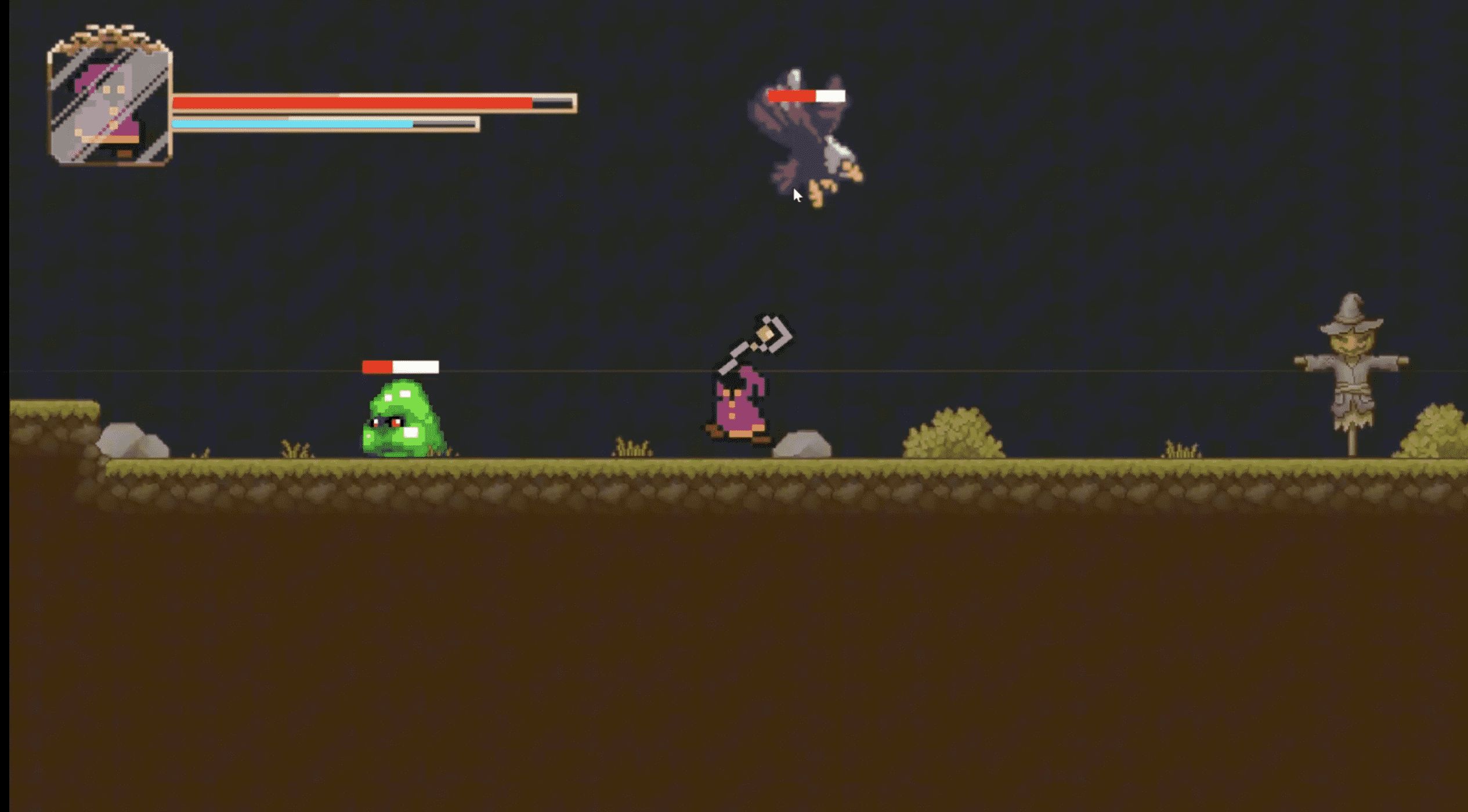
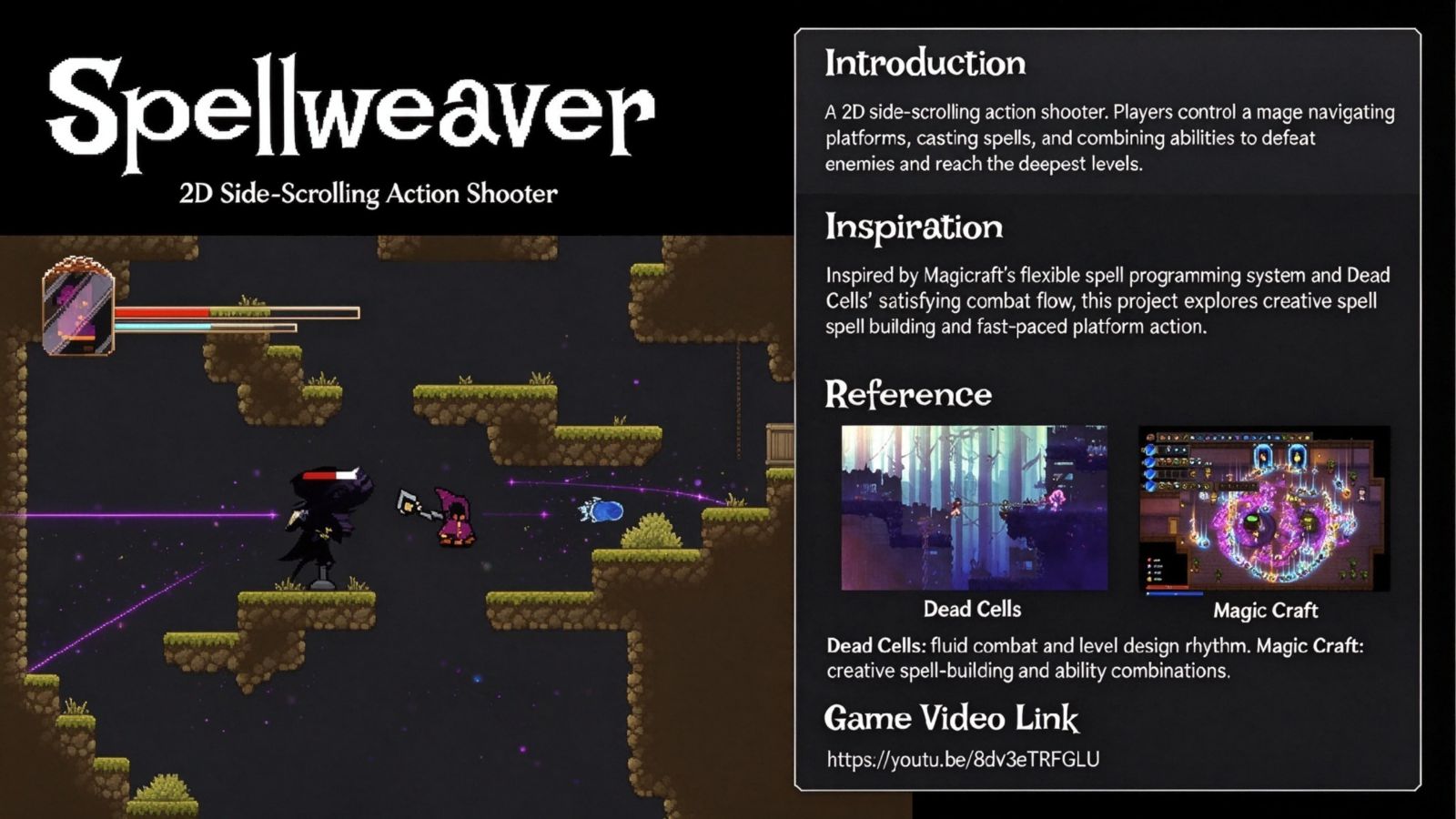
A 2D side-scrolling action-shooter. Players step into the role of a mage venturing into
the Abyss. Through exploration and combat, players collect and learn various spell
nodes. By combining or fusing these nodes, you can construct unique, devastating spells
to defeat the enemies lurking in the depths.
Inspiration
While playing Magic Craft, I was captivated by its highly flexible
"spell programming" system. The ability to create unexpected chemical reactions through
pure permutation and combination was incredibly thrilling. This directly sparked my
drive to create: I wanted to build a game myself, bringing my wildest ideas for spell
combinations to life through code.
Reference
◈
Core Mechanics
Drew heavy inspiration from Noita and Magic
Craft, specifically extracting their brilliant spell-crafting
systems and satisfying character progression loops.
◈
Level & Enemy Design
Referenced classic Metroidvania titles like Hollow Knight and
Dead Cells to design the environment structure and enemy
placement, emphasizing verticality and a deep sense of exploration.
Background Story
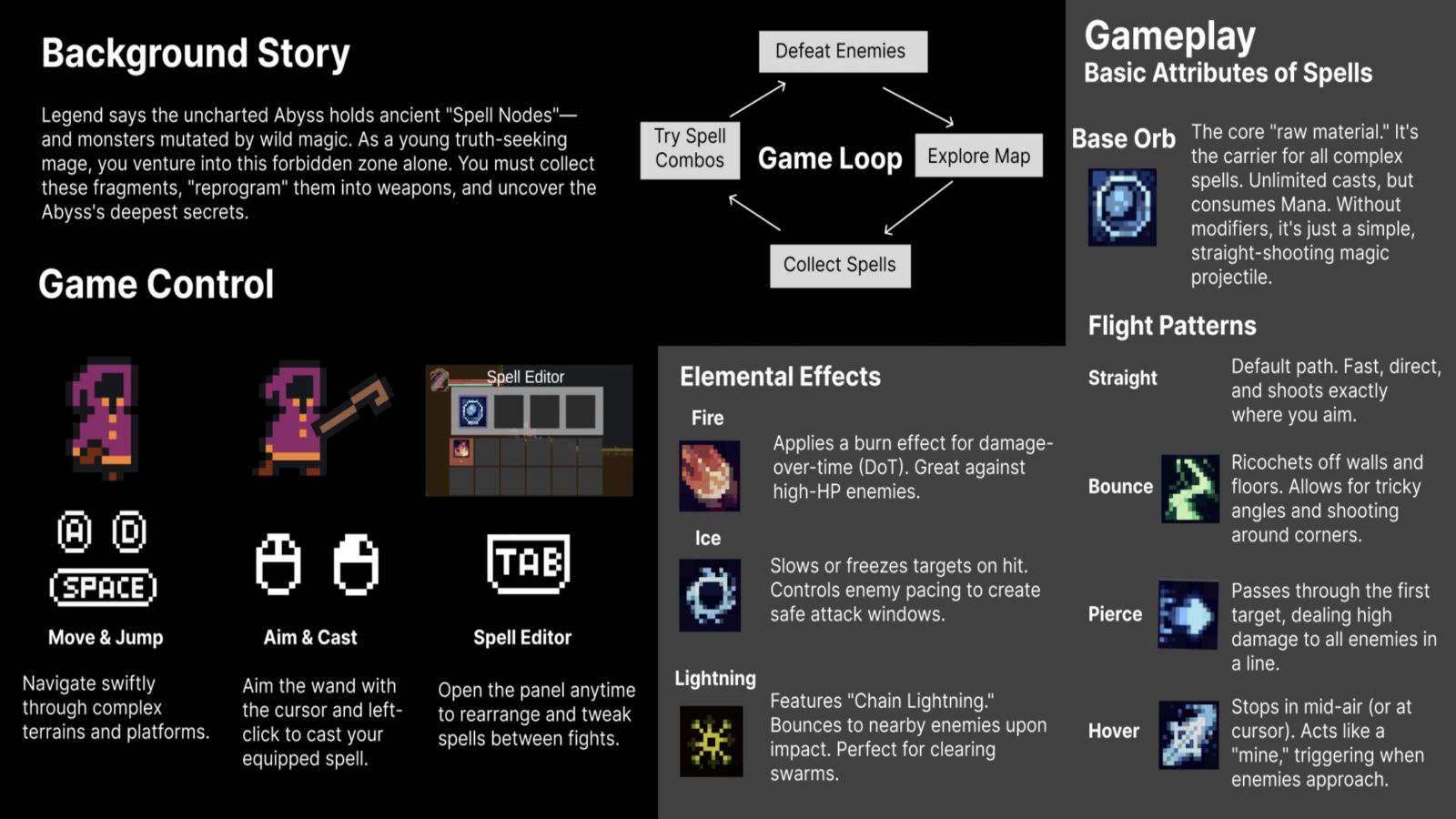
Legend says the uncharted Abyss holds ancient "Spell Nodes"—and monsters mutated by wild
magic. As a young truth-seeking mage, you venture into this forbidden zone alone. You
must collect these fragments, "reprogram" them into weapons, and uncover the Abyss's
deepest secrets.
Game Control
⌨
WASD + SPACE — Move & Jump
Navigate swiftly through complex terrains and platforms.
🖱
Mouse L/R — Aim & Cast
Aim the wand with the cursor and left-click to cast your equipped spell.
▤
TAB — Spell Editor
Open the panel anytime to rearrange and tweak spells between fights.
Game Loop
Defeat Enemies
Battle mutated monsters to secure resources and clear the path forward.
Explore Map
Delve deeper into the Abyss across multi-layered, interconnected terrain.
Collect Spells
Gather spell nodes hidden in hard-to-reach areas and dead-ends.
Try Spell Combos
Rearrange and fuse nodes to craft new spells, then loop back into combat.
Gameplay
◉
Base Orb
The core "raw material." It's the carrier for all complex spells. Unlimited
casts, but consumes Mana. Without modifiers, it's just a simple,
straight-shooting magic projectile.
Flight Patterns
→
Straight
Default path. Fast, direct, and shoots exactly where you aim.
⤾
Bounce
Ricochets off walls and floors. Allows for tricky angles and shooting around
corners.
↦
Pierce
Passes through the first target, dealing high damage to all enemies in a line.
◍
Hover
Stops in mid-air (or at cursor). Acts like a "mine," triggering when enemies
approach.
Elemental Effects
🔥
Fire
Applies a burn effect for damage-over-time (DoT). Great against high-HP enemies.
❄
Ice
Slows or freezes targets on hit. Controls enemy pacing to create safe attack
windows.
⚡
Lightning
Features "Chain Lightning." Bounces to nearby enemies upon impact. Perfect for
clearing swarms.
Gameplay: Spell Editor
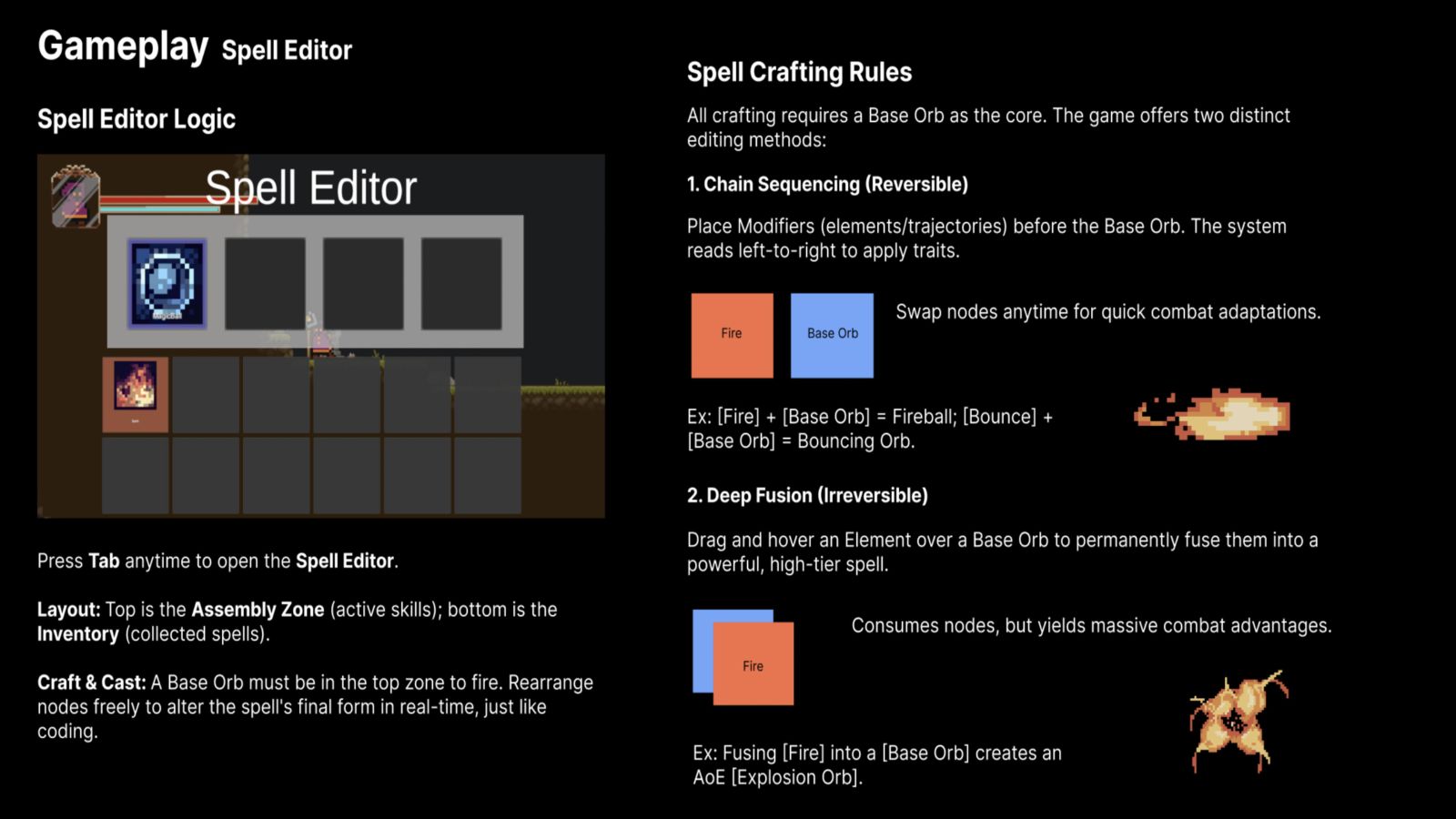
Spell Editor Logic — Press Tab anytime to open the Spell Editor. Layout:
Top is the Assembly Zone (active skills); bottom is the Inventory (collected spells).
Craft & Cast: A Base Orb must be in the top zone to fire. Rearrange nodes freely to
alter the spell's final form in real-time, just like coding.
Spell Crafting Rules — All crafting requires a Base Orb as the core. The
game offers two distinct editing methods:
1. Chain Sequencing (Reversible)
Place Modifiers (elements/trajectories) before the Base Orb. The system reads
left-to-right to apply traits. Swap nodes anytime for quick combat adaptations.
Drag and hover an Element over a Base Orb to permanently fuse them into a
powerful, high-tier spell. Consumes nodes, but yields massive combat advantages.
Ex: Fusing [Fire] into a [Base
Orb] creates an AoE [Explosion Orb].
Level Design
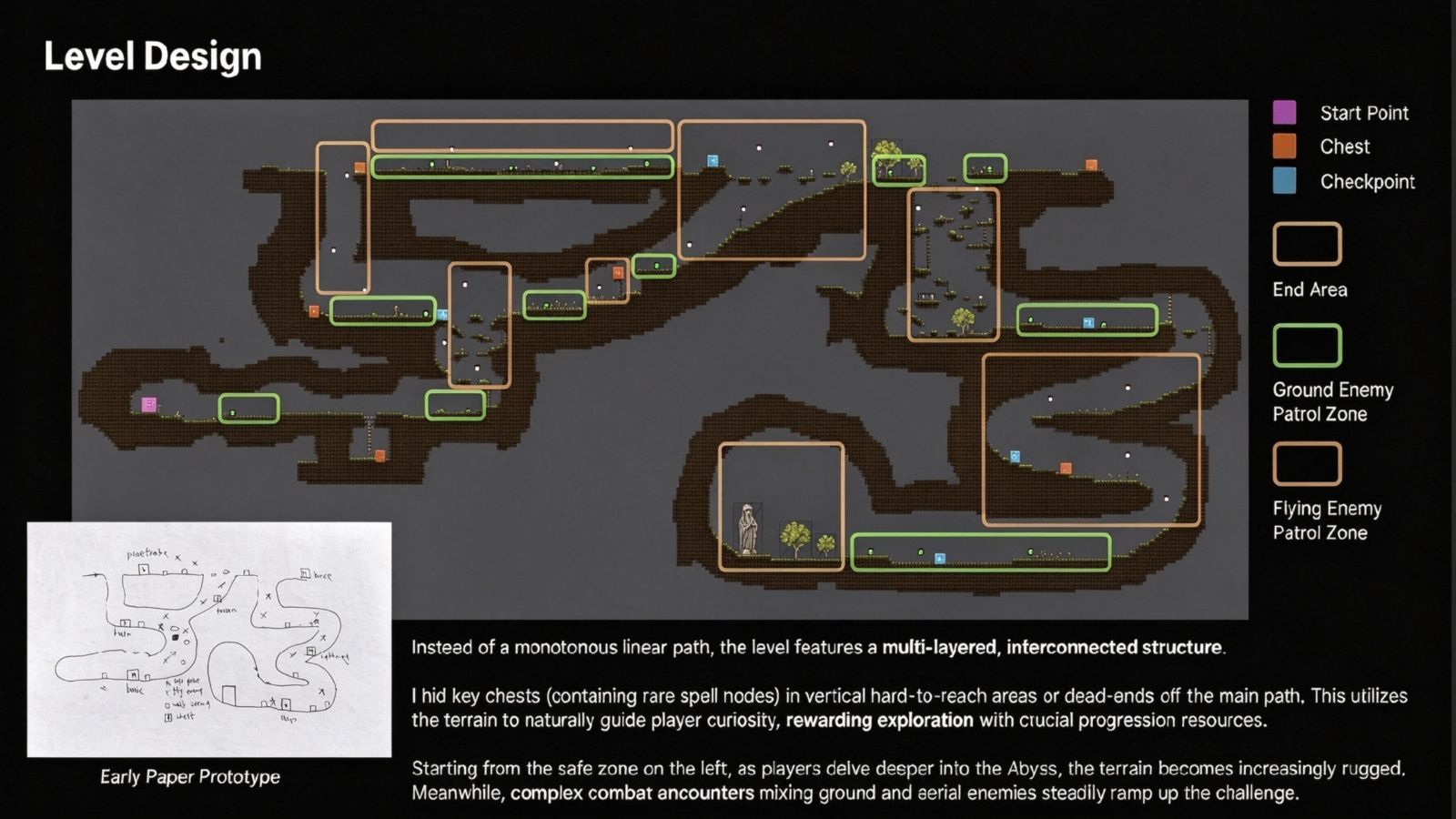
Instead of a monotonous linear path, the level features a multi-layered,
interconnected structure.
I hid key chests (containing rare spell nodes) in vertical hard-to-reach areas or
dead-ends off the main path. This utilizes the terrain to naturally guide player
curiosity, rewarding exploration with crucial progression resources.
Starting from the safe zone on the left, as players delve deeper into the Abyss, the
terrain becomes increasingly rugged. Meanwhile, complex combat encounters mixing ground
and aerial enemies steadily ramp up the challenge.
Code Implementation
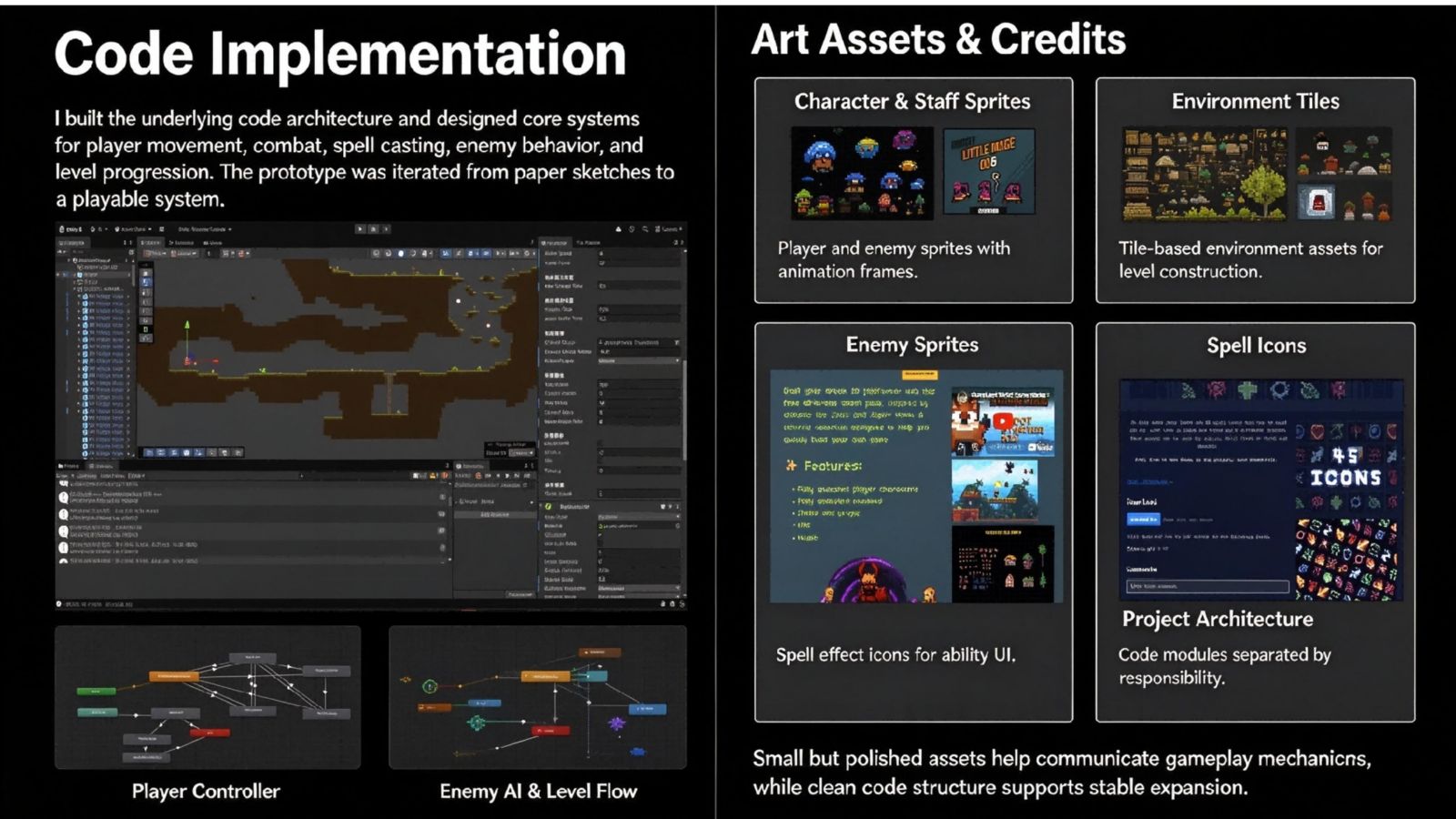
I led the underlying code architecture and utilized an AI assistant to help tackle the
heavy lifting of programming. Through this process, I successfully built the core
Spell Editor and Spell Library, implemented a fluid
character controller, designed two distinct enemy AIs,
and developed a level save system—bringing my initial design blueprint
to life as a fully playable prototype.
Reflection
Spellweaver started from a feeling I got while playing Magic Craft: the thrill of typing
a few nodes together and watching an unexpected spell come out. I wanted to build that
feeling myself. The core of the project became the Spell Editor — a system where the
player assembles spells the way a programmer assembles a program.
What the editor taught me: chain sequencing and deep fusion are not just
two crafting options. Chain sequencing is reversible, read left-to-right, like a line of
code you can reorder at any time. Deep fusion consumes nodes and permanently changes the
spell, like a compile step you cannot undo. Designing those two modes side by side
forced me to think about the spell system as a language: what the grammar is, what can
be composed, and what must be irreversible for the choice to have weight.
What working with an AI assistant changed: I led the architecture and
used Kiro for the heavy lifting. That did not remove the design work — it moved it. I
spent less time typing boilerplate and more time deciding what the Spell Editor should
allow, what it should forbid, and how the level should reward players who experiment.
The tool made the code faster; the thinking about the system stayed mine.
The part I keep coming back to is that a spell system is a small programming language.
The player is not just pressing buttons — they are composing, testing, and revising.
Building that made me understand programming differently: it is not only something you
do in an editor, it is something you can design into a game for someone else to do.