A Journey of Co-Learning — a co-op adventure where a top student and a
struggling student must share one phone and one health bar to overcome the bosses of every subject.
Overview
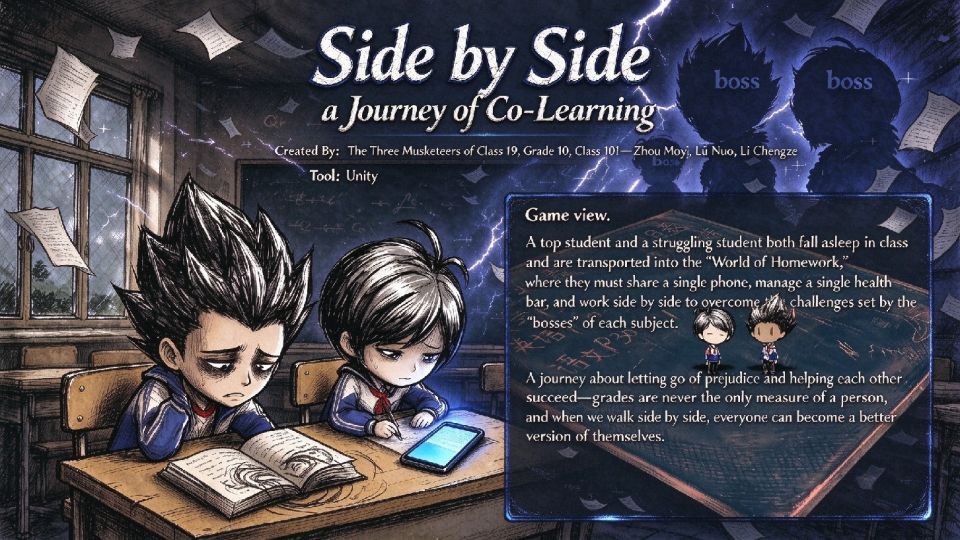
Side by Side — a Journey of Co-Learning is a cooperative educational adventure game built
in Unity. It tells the story of two students — one academically gifted, one struggling —
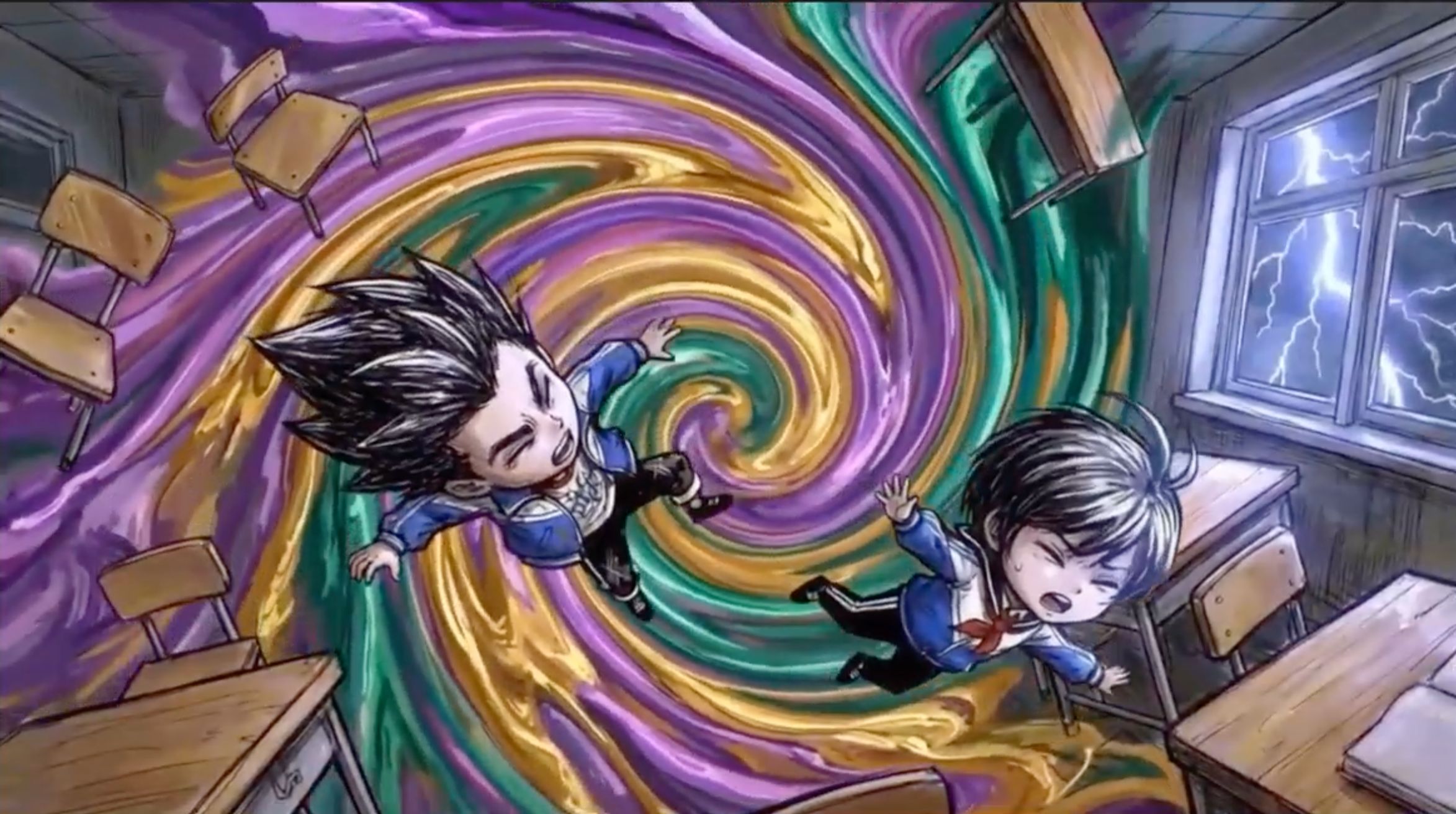
who fall asleep in class and are transported into the "World of Homework."
In this world, they must share a single phone, manage a single shared health bar, and
work side by side to overcome challenges set by the "bosses" of each subject. The game
explores themes of empathy, collaboration, and the idea that grades are never the only
measure of a person.
Background Story
A top student and a struggling student both fall asleep in class — and find themselves
transported into the "World of Homework." In this surreal realm, every subject has its
own boss guarding the path forward.
To escape, the two must put aside their differences and cooperate. They share a single
phone and a single health bar, forcing them to truly work side by side. Only by
combining their strengths can they overcome the trials ahead.
🎒
The World of Homework
A dreamlike realm where classroom subjects become living challenges. Lightning
cracks across the sky of math equations, and ancient scrolls guard the gates of
language arts.
🤝
A Journey of Letting Go of Prejudice
The top student must learn to value different kinds of intelligence. The
struggling student must discover their own strengths. Together, they learn that
everyone can become a better version of themselves.
Gameplay
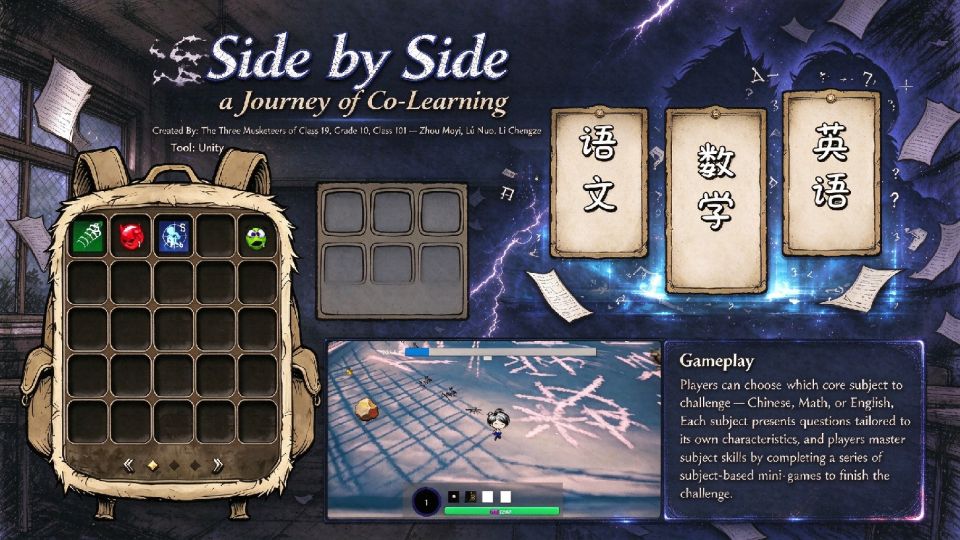
Players can choose which core subject to challenge — Chinese, Math, or English. Each
subject presents questions tailored to its own characteristics, and players master
subject skills by completing a series of subject-based mini-games to finish the
challenge.
📚
Chinese
Language and literature challenges that test reading comprehension, poetic
intuition, and cultural knowledge. Navigate the world of classical texts and
modern prose.
🔢
Math
Logical puzzles and numerical challenges that require quick thinking and pattern
recognition. Battle through geometric labyrinths and algebraic equations.
🔤
English
Vocabulary, grammar, and comprehension trials set in a world of floating letters
and grammar constructs. Master the language to unlock the path forward.
Co-Learning Mechanic
The core innovation of Side by Side is its forced cooperation mechanic. Both players
share a single mobile device and a single health bar — there's no way to survive alone.
📱
Shared Device
One phone, two players. The physical limitation becomes a design feature,
encouraging real-world communication and coordination.
❤
Shared Health
A single health bar for both players. If one falls, both fall. Success requires
mutual protection and strategic coordination.
🧠
Complementary Skills
Each player's academic strengths become their in-game abilities. The "top
student" excels at certain subjects while the "struggling student" brings
unexpected creative solutions.
Characters
The two protagonists represent different student archetypes, but the game challenges
players to see beyond labels:
✨
The Top Student
Academically gifted but perhaps isolated by expectations. In the World of
Homework, they must learn to trust and rely on someone else's strengths.
🌱
The Struggling Student
Underestimated by grades but rich in creative thinking and resilience. Their
unique perspective becomes essential to solving the game's challenges.
Development
Side by Side was created by "The Three Musketeers of Class 19, Grade 10, Class 101" —
Zhou Moyi, Lü Nuo, and Li Chengzhe — using Unity. The project reflects the team's belief
that games can be a powerful medium for social-emotional learning.
The hand-drawn, picture-book visual style evokes the intimacy of a storybook while the
classroom setting grounds the fantasy in relatable reality. Every design choice serves
the central message: when we walk side by side, everyone can become a better version of
themselves.
UnityHand-drawn Art3-person TeamEducational
Reflection
Side by Side was my first attempt at a commercial project, made with two high school
classmates. It did not go well. We ran out of time, the gameplay stayed thin, and the
final version did not reach the goal we set at the start. I am not going to pretend
otherwise.
What went wrong was not only the game. We treated this like a bigger
school project: design it, build it, polish it, done. But a commercial product has to
answer questions that a school project never asks — who is this for, why would they
choose it over something else, how will they ever find it, and what makes it worth
paying for. We did not have answers to those questions, and we did not know we needed
them until it was too late.
What I actually learned: development is only one part of a commercial
product, and honestly not the largest part. Market, positioning, timing, and the way you
talk about the game matter just as much. A well-built game with no audience is not a
success; a rough game with a clear audience can be. I had spent years getting better at
building, and this project showed me that building was never the whole job.
What I carry forward: before starting something commercial, ask the
market questions first, not last. Who is it for, how will they hear about it, and why
this instead of the ten other things they could do. I am glad this happened with a small
project and two friends rather than a big one — the lesson was cheap, and I will not
forget it.