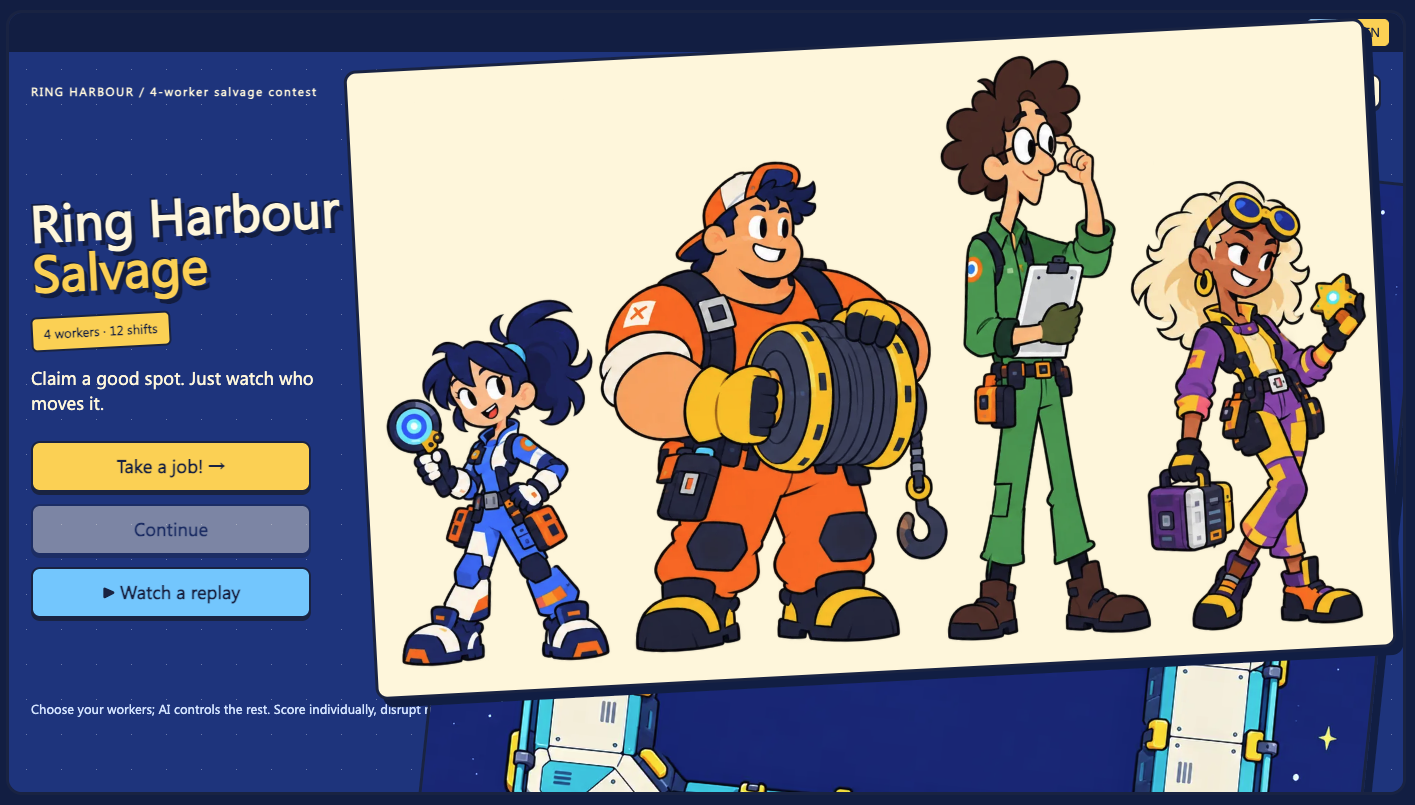
A turn-based space salvage competition on a ring-shaped harbour. Four
workers, twelve shifts, and a race to claim the best cabins before someone else moves them.
Overview
RingRival (subtitled Ring Harbour Salvage) is a turn-based tactical competition
set on a ring-shaped spaceport. Four salvage workers spend twelve shifts racing to
survey sealed cabins, collect cargo, and outscore their rivals. The harbour is a closed
loop of twenty-four positions — every move changes not just your position, but the
relative distances between all four workers.
The core tension is spatial: claim a good spot, but watch who moves it. A cabin that
looks
safe on your turn might be nudged, towed, or swapped away before you can salvage it.
The game rewards both careful route planning and opportunistic disruption.
Crew & Roles
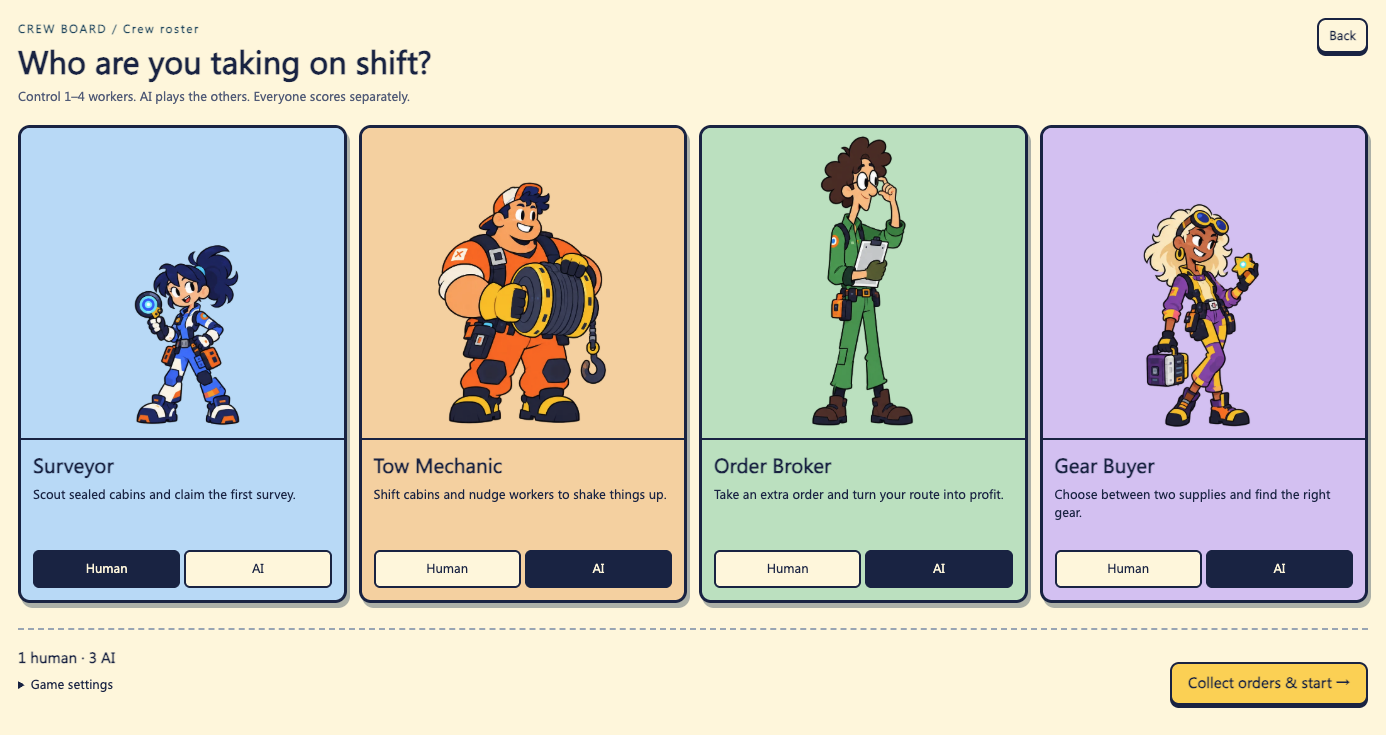
Before each game you assemble a crew of four from four distinct roles. You control
between one and four workers directly; the rest follow automated behavior patterns based
on their role and current board state.
Surveyor. Scouts sealed cabins and claims the first survey bonus.
Excels at early reconnaissance and route optimization.
Tow Mechanic. Shifts cabins and nudges workers to shake up the
board.
The only role that can physically relocate cargo containers and alter the spatial
landscape for everyone.
Order Broker. Takes extra orders and turns route efficiency into
profit. Focuses on completing delivery contracts for bonus points.
Gear Buyer. Chooses between two supply options and finds the right
gear for the job. Specializes in equipment acquisition and tool management.
The Ring Harbour
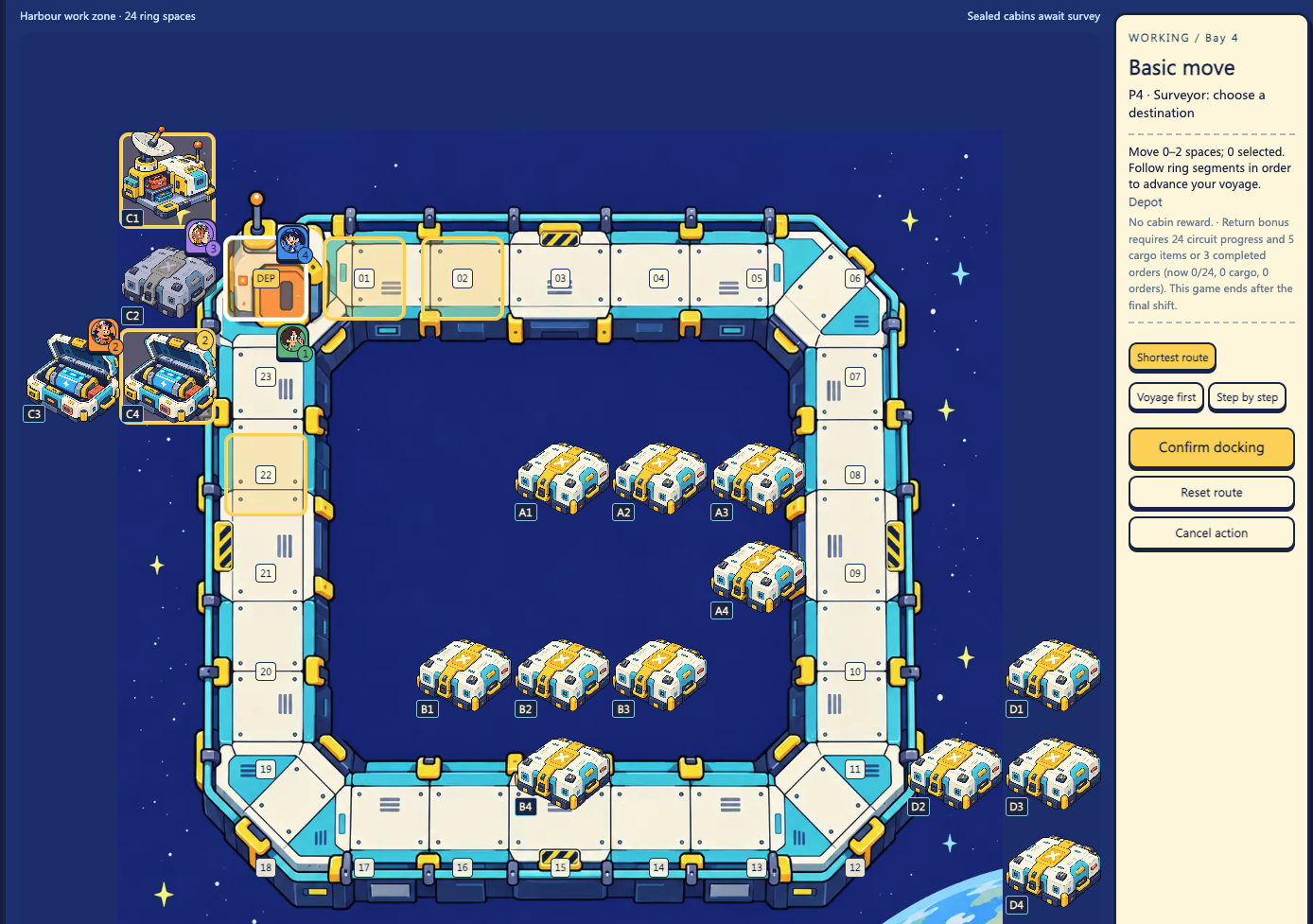
The battlefield is a continuous ring of twenty-four numbered positions. Workers travel
along ring segments in order, advancing their voyage step by step. Key locations
include:
Depot. Starting point and safe zone. Workers at the depot are
protected from forced movement.
Sealed Cabins. The primary scoring objective. Surveying a cabin
reveals its contents — common components or rare cores — and awards first-visit
points.
Return Threshold. Completing a full circuit and returning to the
depot triggers a return bonus, but requires twenty-four circuit progress and five
cargo items or three completed orders.
Movement is constrained by gear and worker capabilities: basic moves cover 0–2 spaces,
thrust tickets extend range up to 5 spaces (including ring-road boosts), and booster
jets
provide extra mobility. The ring topology means every move is simultaneously a forward
advance and a change in relative position against every other worker.
Gear & Equipment System
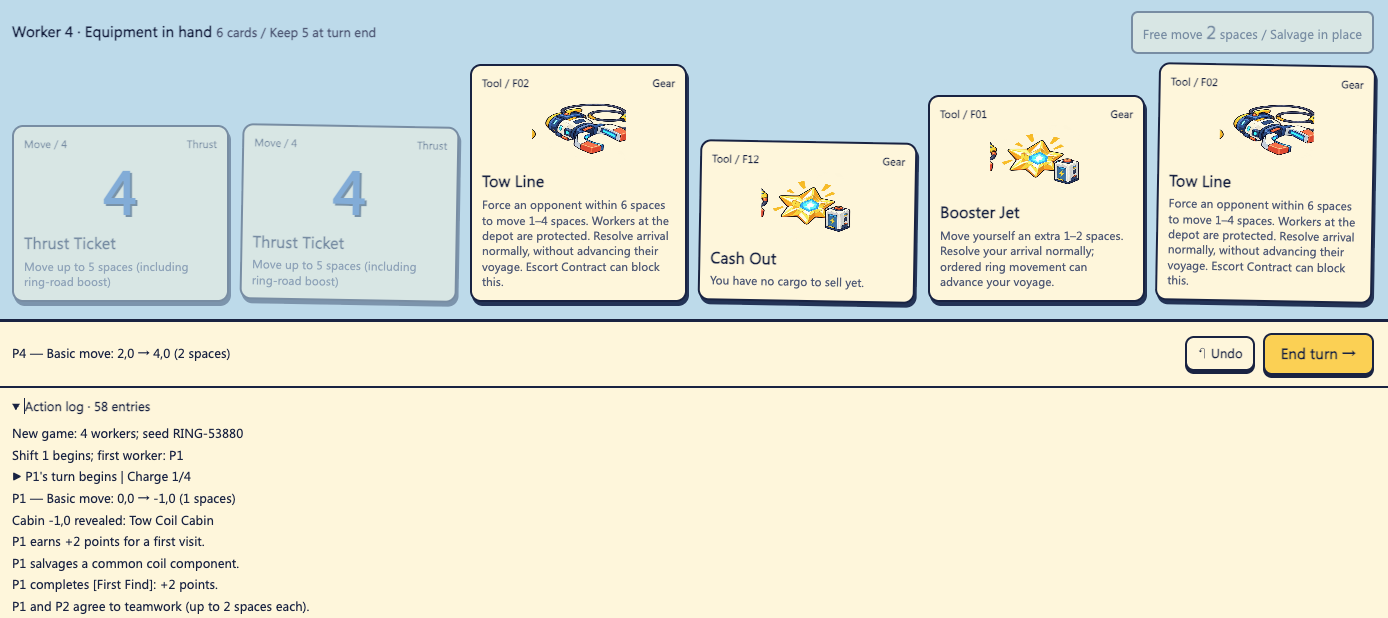
Each worker carries a personal equipment deck of up to six cards, keeping five at turn
end.
Gear defines what a worker can do on their shift:
Thrust Ticket. Move up to 5 spaces including ring-road boost. The
basic mobility tool for rapid repositioning.
Tow Line. Force an opponent within 6 spaces to move 1–4 spaces.
Workers at the depot are protected. A direct disruption tool for sabotaging rival
routes.
Booster Jet. Move yourself an extra 1–2 spaces. Self-propelled
mobility override for breaking through blockades.
Cash Out. Convert held cargo into points. Timing matters — selling
too early leaves potential value on the table; too late and a rival might steal the
cargo first.
Equipment is gained through cabin rewards, shop purchases, and role-specific abilities.
Managing hand composition across twelve shifts is as important as board positioning.
Scoring & Victory
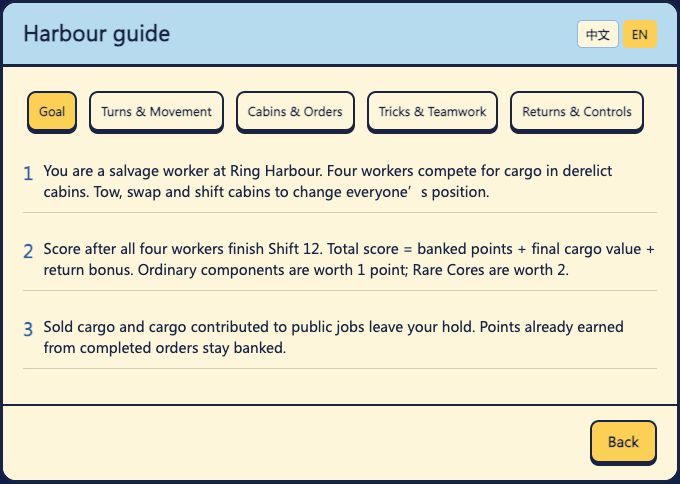
After all four workers complete Shift 12, total score is calculated from three sources:
Banked points — earned from completed orders and first-visit
surveys,
permanently locked in.
Final cargo value — remaining cargo in hold at game end. Ordinary
components worth 1 point; Rare Cores worth 2.
Return bonus — awarded for completing a full circuit and returning
to depot with sufficient cargo and orders.
Sold cargo and cargo contributed to public jobs leave your hold permanently. The tension
between banking early points and holding out for higher-value cargo is the central
economic decision of every game.
Interface & Systems
The game features a fully bilingual interface (Chinese / English toggle) with contextual
help panels. The Harbour Guide breaks rules into five sections — Goal, Turns & Movement,
Cabins & Orders, Tricks & Teamwork, and Returns & Controls — ensuring players can learn
the game without leaving the match.
An action log records every move with 58+ entry types, from basic movement and cabin
reveals to teamwork agreements and equipment usage. This log serves as both a tutorial
feedback loop and a replay system for post-game analysis.
Design Notes
RingRival started as an exploration of closed-loop spatial competition. The ring topology
creates a peculiar strategic property: every move is simultaneously progress toward
your own goal and a change in the relative geometry against every opponent. Unlike
linear race games where leading is always good, RingRival makes proximity itself a
resource — being close to a rival means you can tow their cabin away, but it also means
they can do the same to you.
The four roles were designed to create asymmetric but balanced incentives. The Tow
Mechanic changes the board for everyone; the Surveyor benefits from an undisturbed
board;
the Order Broker wants rapid circuit completion; the Gear Buyer wants to linger and
acquire. No single strategy dominates because the optimal play depends on which roles
are
present and who controls them.
The equipment system adds a second layer of hidden information: your hand composition
determines what disruptions you can attempt, but opponents only see the results, not
the cards. This creates bluffing opportunities — a worker with no Tow Line who
approaches
a rival anyway may trigger a defensive overreaction.
Spatial StrategyAsymmetric RolesClosed-Loop TopologyHidden Information
Reflection
Ring Rival looks like a rich game. There are layered panels, glowing cabins, animated
workers, a board that shifts with every turn. But if you strip the styling away, the
game is mostly simple pages: some containers, some text, some buttons, and a set of
state changes. The richness is not coming from the complexity of the pages. It is coming
from what was done to them.
What I had assumed: I used to think a rich interface meant a complex
system underneath. More mechanics, more screens, more code — more of everything to make
it feel like a real game. Building Ring Rival taught me the opposite. The underlying
structure could stay small; the feeling of depth came from color, spacing, motion,
borders, gradients, and the timing of small animations. Styling was doing most of the
work of making it feel like a game at all.
What changed in how I see interface design: a simple page with
deliberate styling can feel deep, and a complex system with careless styling still looks
like a prototype. Players do not read the architecture. They read what they see and what
moves. That means styling is not the last decorative step after the “real” design is
finished. On a screen, the visual layer is the game as the player experiences it.
What I carry forward: I now treat styling as design, not decoration.
Before, I thought of it as polishing — something you do if there is time left. Now I
plan it alongside the mechanics, because the same set of simple pages can feel rich or
empty depending entirely on how carefully someone thought about how they should look and
feel.