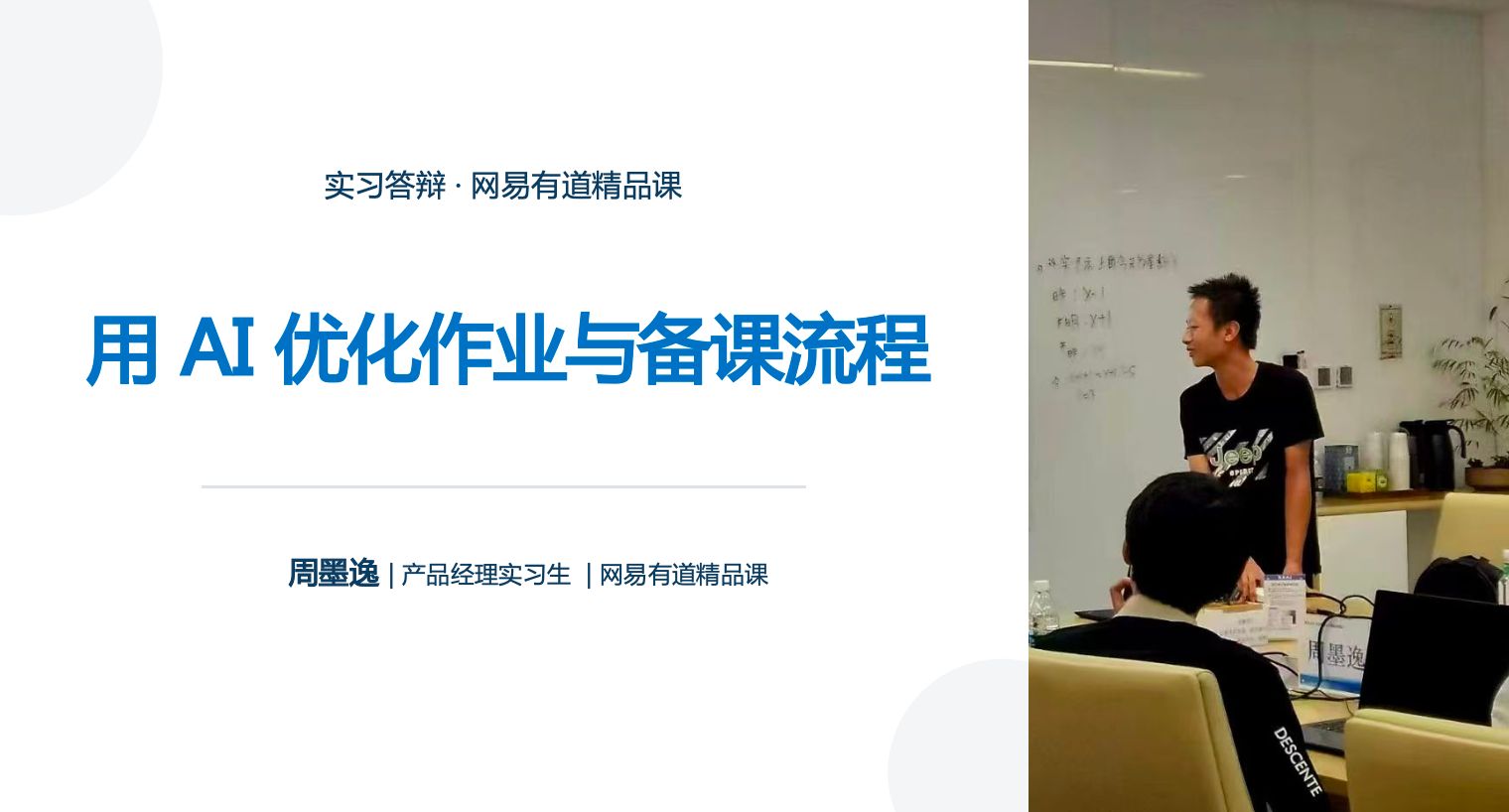
NetEase: AI Optimizes Homework

Product Manager Intern at NetEase Youdao. Designed an AI-powered oral English practice workflow — from user research and competitive analysis to technical validation and high-fidelity prototype design.

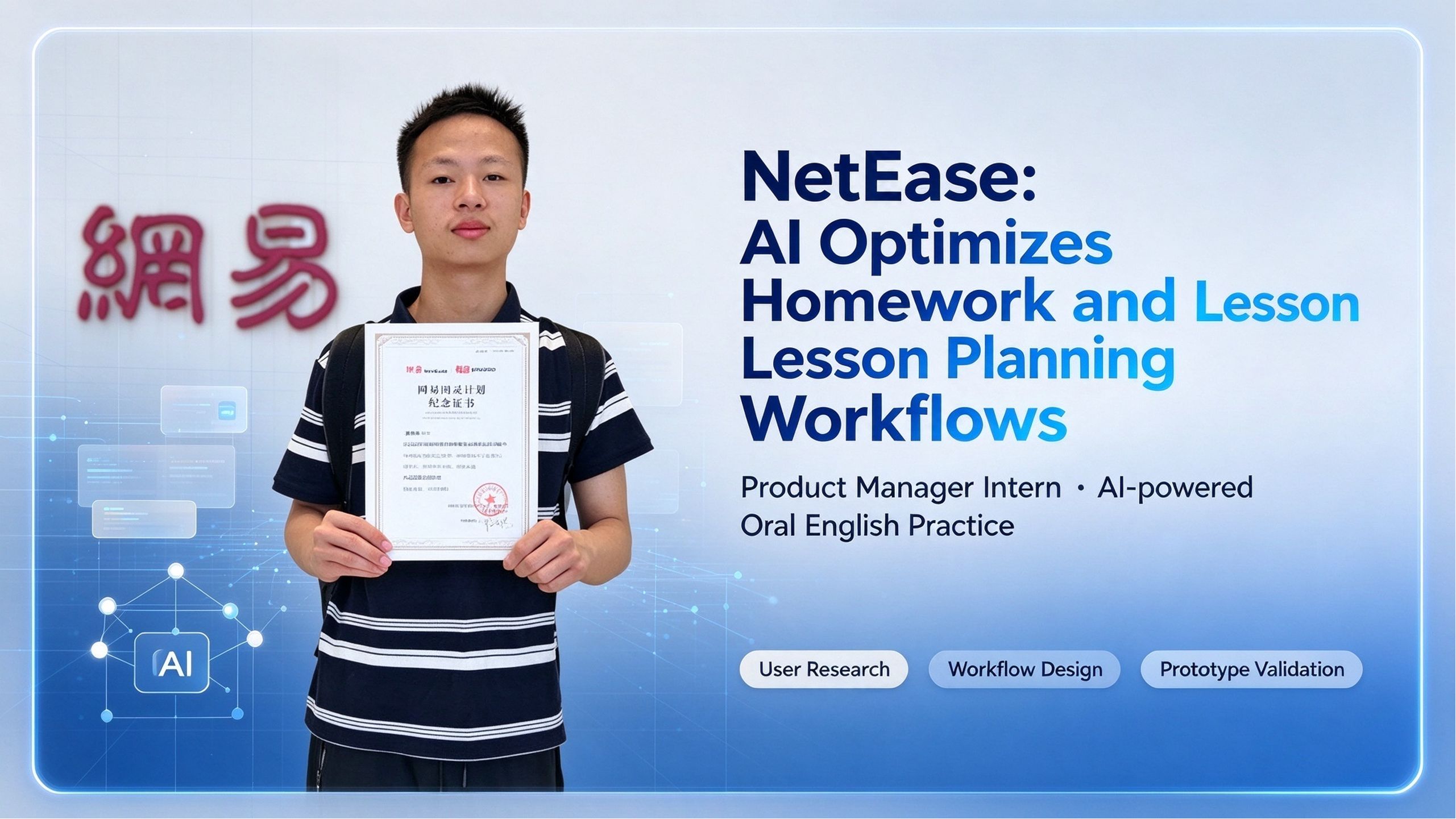
NetEase Internship Certificate

Overview

During a four-week summer internship at NetEase Youdao, I joined the "Turing Plan" AI Summer Practice Program as a Product Manager Intern. I focused on one core project aligned with Youdao's actual product needs: AI-powered oral English homework practice.

The internship followed a rigorous full-time schedule — daily stand-ups, weekly deliverables, and a formal final presentation.

NetEase Internship Certificate

Product Management Practice

Problem Discovery. Through deep interviews with frontline teachers, I identified three core pain points in the oral English homework workflow:

  • Excessive parent involvement: Young students lack independent devices. Parents must assist with recording and uploading video homework, creating a heavy invisible burden beyond tuition fees.
  • Unreliable technical path: Large video files cause low upload success rates. Teachers report frequent workflow interruptions, significantly increasing homework management costs.
  • Inefficient feedback: Manual grading takes days. By the time feedback arrives, students have forgotten their practice, losing the timeliness critical for oral skill development.

User Research Insights. I interviewed teachers across age groups and found that "one-size-fits-all" designs fail — upper-grade teachers found the system acceptable, while lower-grade teachers and parents experienced severe usability issues. Some parents bypassed the official system entirely, sending homework via WeChat instead.

Competitive Analysis. I analyzed leading oral English apps: Lexuexiu (乐学秀) for its closed-loop "practice → score → analysis" feedback chain; Xinshu Oral (新述口语) for KET/PET exam simulation; Zebra Oral (斑马口语) for child-friendly UI that reduces parent dependency. I also studied Duolingo's gamification: level achievements, stage unlocking, and instant positive feedback.

Technical Validation. I tested Volcano Engine's Doubao speech model for real-time oral reading evaluation. Results confirmed: (1) stable "demo → read → score → continue" loop with minimal latency; (2) accurate rejection of off-task inputs like singing or chatting; (3) 100-200 character structured prompts performed best.

Solution Design. The "AI oral examiner" enables students to practice independently anytime, eliminating parent dependency. Key features include:

  • Three-dimensional scoring: pronunciation, fluency, and intonation with specific improvement suggestions
  • AI personalized feedback: warm, human-like commentary instead of cold numbers, telling parents exactly how their child performed and what to improve
  • Error cause analysis: for multiple-choice questions, the system explains why the wrong answer was selected and identifies knowledge gaps
  • Age-differentiated design: separate interfaces and interaction patterns for lower vs. upper grades
Challenges & Breakthroughs

Prompt Effectiveness. Early tests revealed that lengthy instructions with soft phrasing like "suggested/if" were ignored by the AI. I developed a structured short-prompt methodology: 100-200 characters, direct "condition → action" mapping, eliminating redundant modifiers to establish hard constraint boundaries.

User Perspective. I initially fell into the trap of data piling — listing click counts and operation paths. Parents don't want spreadsheets; they want to know "how is my child doing and what should we improve?" I pivoted to AI-generated personalized warm feedback that translates raw data into actionable growth guidance.

Flexible Decision-Making. When a technical approach proved unworkable, I quickly pivoted to an AI-driven alternative. The lesson: don't waste time fixing fundamentally flawed inputs — change the approach.

Reflection

This internship changed how I approach product design — I no longer start from "what features can I add," but from "whose real problem is this, and is it worth solving." The shift from student thinking to product thinking was the most valuable takeaway.

What still needs work: in interviews I sometimes settled for vague "pretty good" answers instead of probing into concrete behaviors; and when writing reports I initially took the data owner's perspective rather than the reader's.

What four weeks taught me about proof: I could not build the full AI oral examiner and then see whether it worked. I had to find the smallest thing that would prove or disprove the core assumption first. Before designing any interface, I tested the Volcano Engine Doubao speech model directly — a stripped-down loop of "demo → read → score → continue." That test confirmed the latency was acceptable, the model correctly rejected off-task inputs, and structured prompts of 100–200 characters performed best. Without that minimum viable test, I might have spent two weeks designing a workflow around a model that could not deliver. MVP thinking also shaped the final deliverable: a working prototype that demonstrated the core loop was worth more than a polished deck describing a product that had never been tested.

THE SHIFT From student thinking to product thinking. THEN · STUDENT MINDSET WHAT CAN I BUILD + FEATURE ACCUMULATION Build All First · Validate Later NOW · PRODUCT MINDSET WHAT SHOULD I BUILD + FOR WHOM Prove Smallest First · Learn Fast