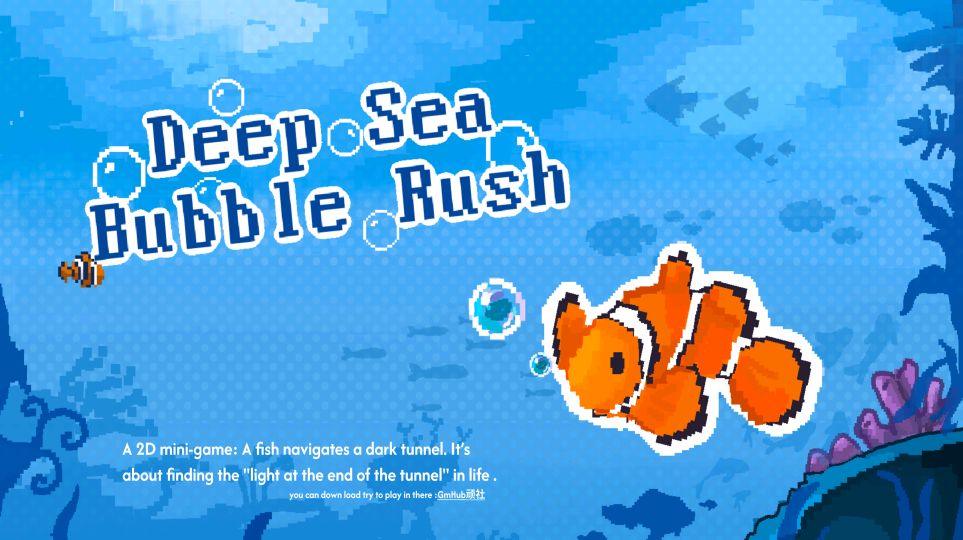
A 2D mini-game: A fish navigates a dark tunnel. It's about finding the "light
at the end of the tunnel" in life.
Overview
Deep Sea Bubble Rush is a 2D mini-game developed for Global Game Jam 2025. Players
control a little clownfish navigating dark, twisting underwater tunnels to find its way
back to safe waters. Along the journey, the fish must collect bubbles to break
obstacles, avoid hazards, and escape the dangers lurking in the deep.
The game blends adventure, puzzle-solving, and hidden-object mechanics with charming
pixel art and an underwater theme. It was built using C++ and features hand-drawn
artwork created in Procreate.
Characters
◈
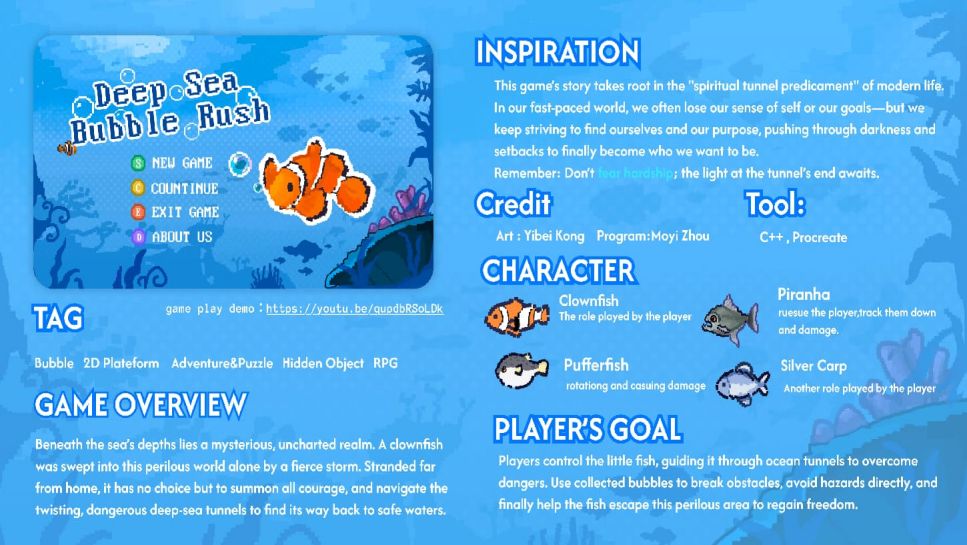
Clownfish
The brave protagonist controlled by the player. Swept away by a storm, it must
navigate the dangerous tunnels to return home.
◈
Piranha
Aggressive predators that chase the player through the tunnels, dealing damage on
contact.
◈
Pufferfish
Defensive enemies that rotate and expand, causing damage when the player gets too
close.
◈
Silver Carp
Another playable character option, offering a different visual experience while
maintaining the same gameplay mechanics.
Key Features
◈
2D Platformer Adventure
Navigate dark underwater tunnels, collect bubbles, break obstacles, and avoid
hazards in a thrilling deep-sea journey.
◈
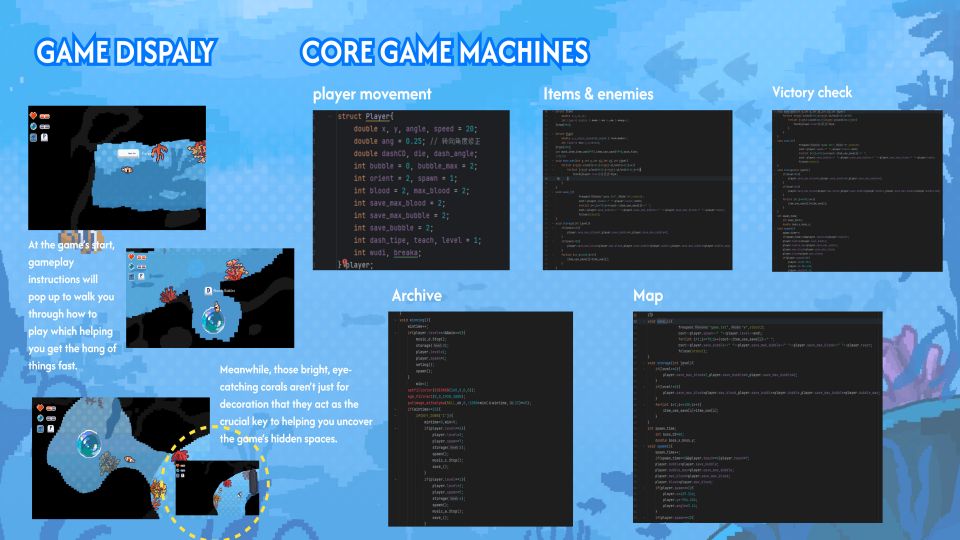
Hidden Object Discovery
Bright, eye-catching corals act as crucial keys to uncover the game's hidden
spaces and secret areas.
◈
Puzzle Mechanics
Use collected bubbles strategically to break through barriers and overcome
environmental challenges.
◈
Charming Pixel Art
Hand-drawn pixel art style created in Procreate, featuring adorable sea creatures
and vibrant underwater environments.
Game Story
Beneath the sea's depths lies a mysterious, uncharted realm. A clownfish was swept into
this perilous world alone by a fierce storm. Stranded far from home, it has no choice
but to summon all courage and navigate the twisting, dangerous deep-sea tunnels to find
its way back to safe waters.
The game's narrative draws inspiration from the "spiritual tunnel predicament" of modern
life. In our fast-paced world, we often lose our sense of self or our goals—but we keep
striving to find ourselves and our purpose, pushing through darkness and setbacks to
finally become who we want to be. Remember: Don't fear hardship; the light at the
tunnel's end awaits.
Level Design
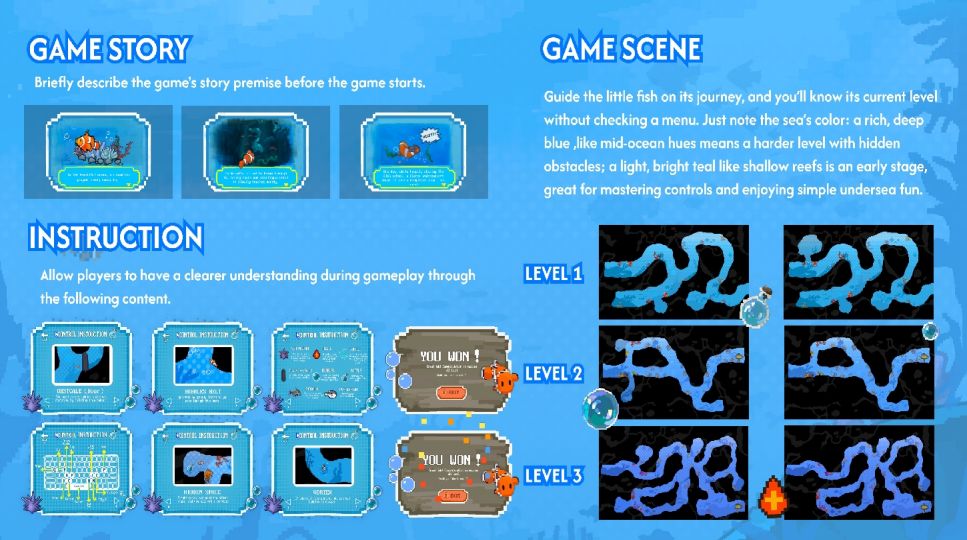
The game features three distinct levels, each with increasing difficulty and unique
visual themes:
Level 1: Bright, shallow reef environments in light teal—an early
stage for mastering controls and enjoying simple undersea fun.
Level 2: Mid-ocean hues in deeper blue with hidden obstacles,
introducing more complex tunnel layouts.
Level 3: Darkest depths with the most challenging maze-like
passages, requiring precise bubble management.
The sea's color serves as a visual indicator of difficulty: brighter colors indicate
easier stages, while darker blues signal harder challenges ahead.
Core Game Machines
The game engine is built from the ground up in C++, featuring several core systems:
Player Movement: Smooth 2D character controller with swimming
physics, dash mechanics, and responsive input handling.
Items & Enemies: Bubble collection system with resource management,
plus enemy AI for Piranha (pursuit), Pufferfish (rotational attack), and
environmental hazards.
Victory Check: Level completion detection based on reaching the
tunnel exit while managing health and bubble resources.
Save System: Persistent game state saving progress and high scores
across sessions.
Map System: Dynamic level loading with tile-based map rendering and
collision detection.
Reflection
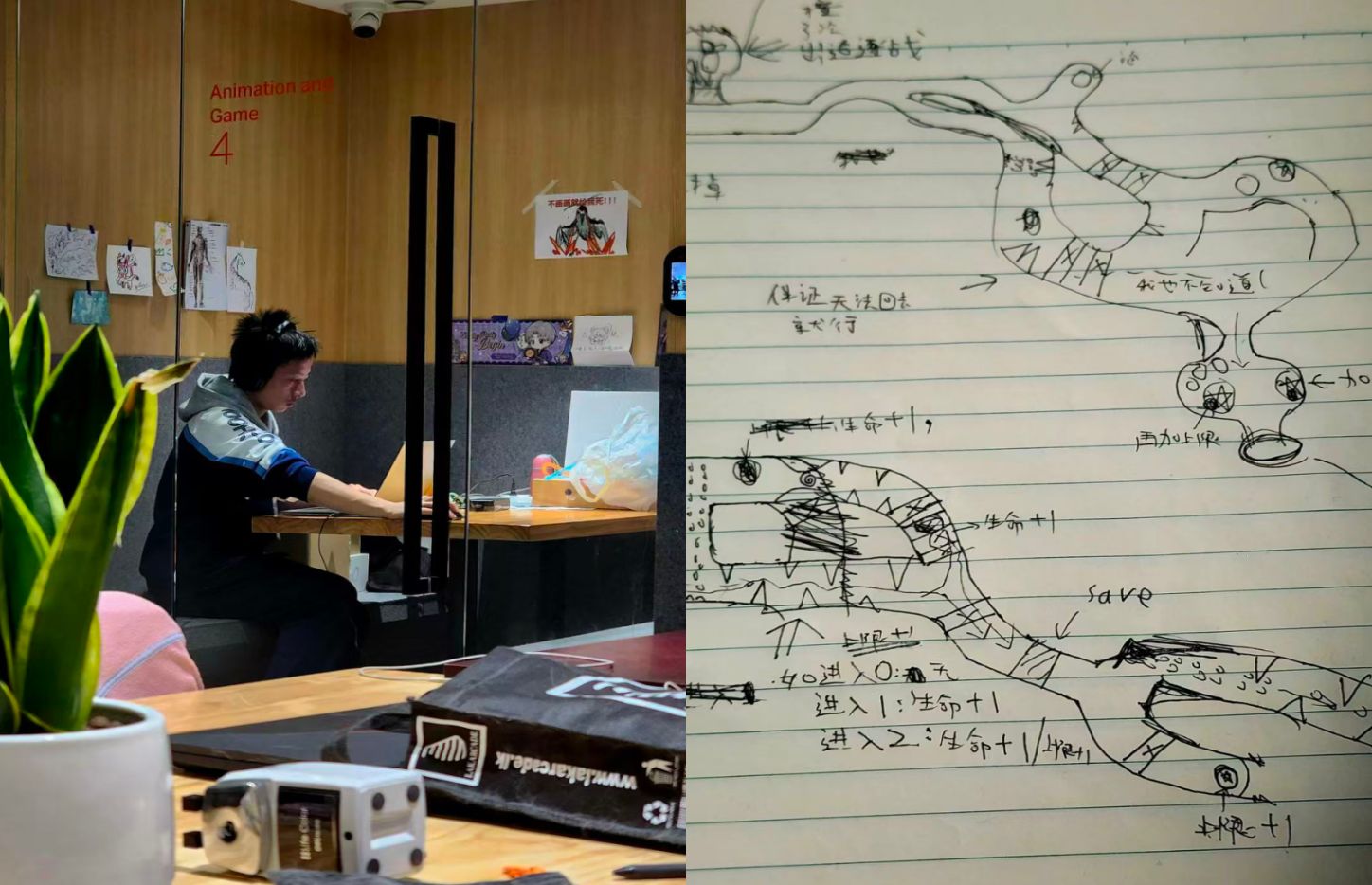
Deep Sea Bubble Rush was my first Game Jam. I went in thinking a jam was a compressed
version of normal development — same process, less time. Plan the systems, build them in
order, polish what you can before the clock runs out. That assumption lasted about six
hours.
What actually happened: the plan was the first thing to go. With one
collaborator and no engine, every hour spent defending the original scope was an hour
not spent making the game feel right. I learned to cut features before they were built,
to let Yibei's art set the emotional target and then build only the systems that served
it, and to treat "playable" as a milestone worth reaching early rather than a state you
arrive at the end.
What changed in how I see jams: a jam is not a smaller project. It is a
different way of making — one where the feeling decides the scope, not the other way
around. That was the real first-timer lesson: stop protecting the plan, start protecting
the moment. I carry that into every project now, jam or not.