AI Series AP3D Works

Five mixed-media installations exploring the origin, evolution, and symbiotic relationship between artificial intelligence and humanity — built from discarded circuit boards, EL wire, acrylic, and light.

AI Series AP3D Works — Collection Overview

Overview

Tree of Origin — AP 3D Installation

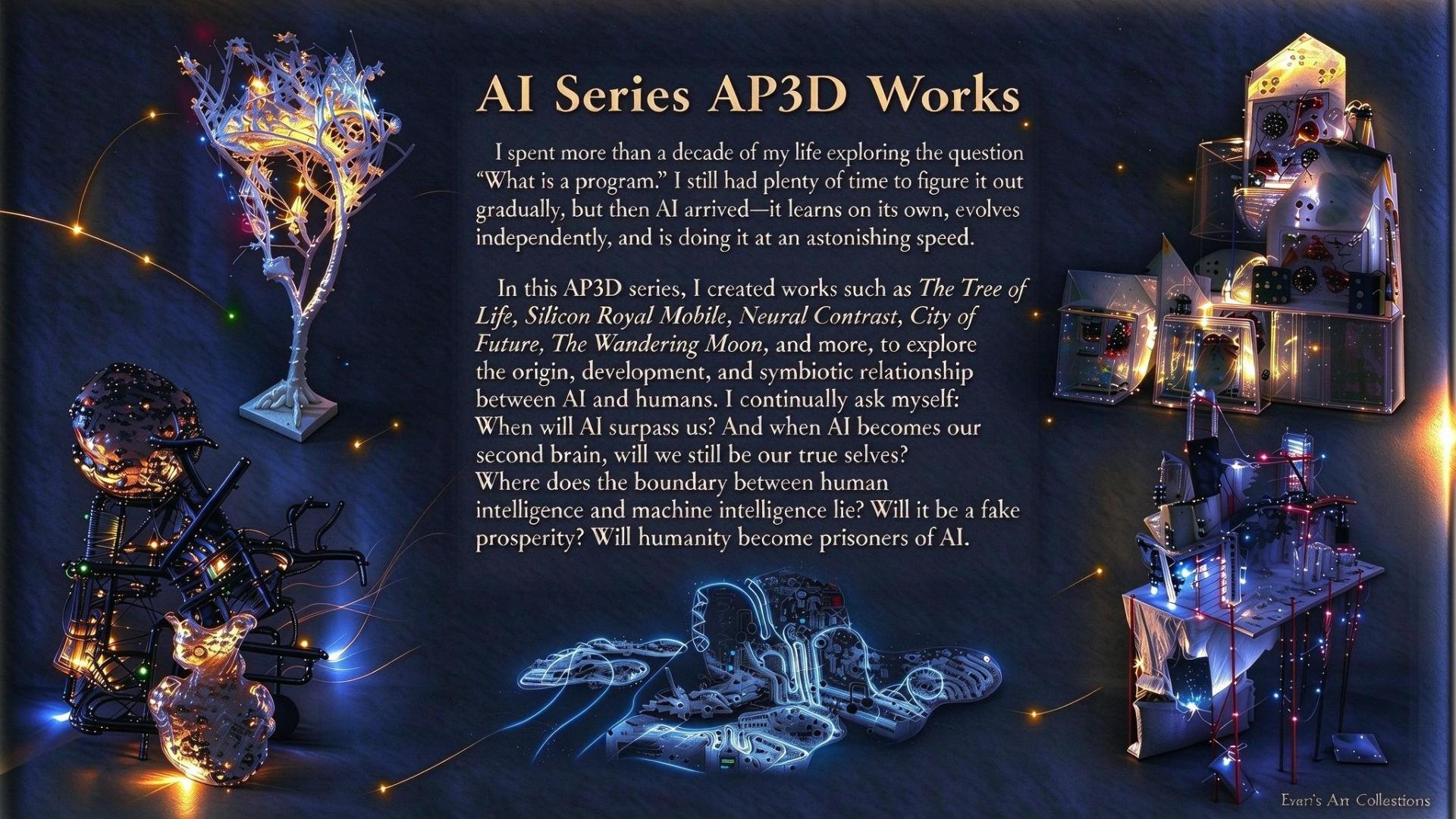
This AP 3D Art series is my visual inquiry into a question that has occupied me for years: What is a program? I spent more than a decade of my life exploring this idea, and then AI arrived — it learns on its own, evolves independently, and is doing so at an astonishing speed.

In this series, I created five works — Tree of Origin, Silicon Skin, Neural Silhouette, Relic Metropolis, and Shadow Symbiosis — to explore the origin, development, and symbiotic relationship between AI and humans. I continually ask myself: When will AI surpass us? And when AI becomes our second brain, will we still be our true selves? Where does the boundary between human intelligence and machine intelligence lie?

Each piece is constructed from discarded electronic components, circuit boards, wires, LED and EL lights, acrylic sheets, and found objects. The materials themselves tell part of the story: technology that has been cast aside, repurposed to question the very system that produced it.
Work 1 — Tree of Origin

Tree of Origin — AP 3D Installation

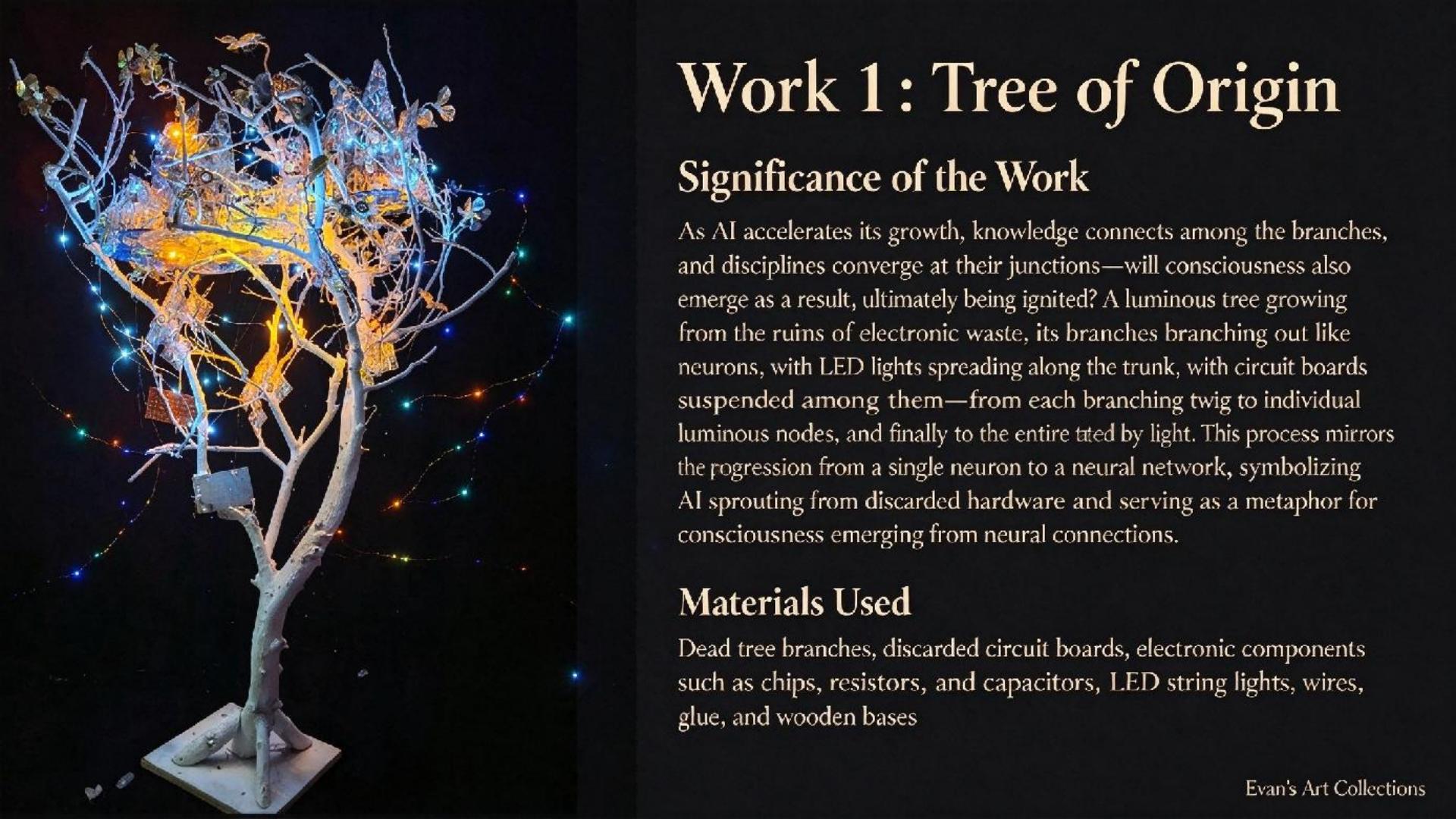
Significance: As AI accelerates its growth, knowledge connects among the branches, and disciplines converge at their junctions — will consciousness also emerge as a result, ultimately being ignited? A luminous tree growing from the ruins of electronic waste, its branches branching out like neurons, with LED lights spreading along the trunk, with circuit boards suspended among them — from each branching twig to individual luminous nodes, and finally to the entire tree lit by light. This process mirrors the progression from a single neuron to a neural network, symbolizing AI sprouting from discarded hardware and serving as a metaphor for consciousness emerging from neural connections.

Materials: Dead tree branches, discarded circuit boards, electronic components such as chips, resistors, and capacitors, LED string lights, wires, glue, and wooden bases.

Work 2 — Silicon Skin

Silicon Skin — AP 3D Installation

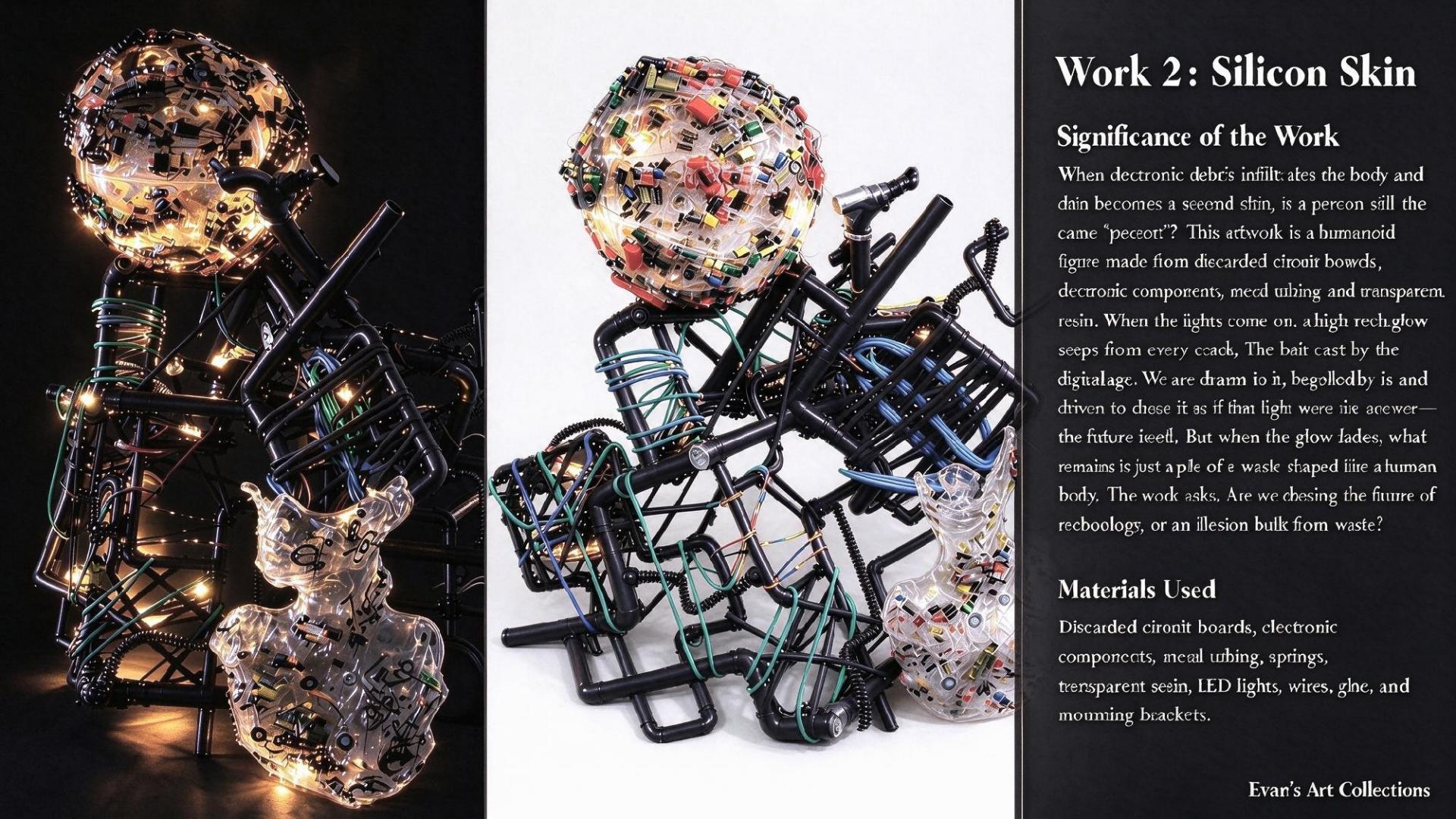
Significance: When electronic debris infiltrates the body and skin becomes a second skin, is a person still the same "person"? This artwork is a humanoid figure made from discarded circuit boards, electronic components, metal tubing and transparent resin. When the lights come on, a high-tech glow seeps from every crack. The bait cast by the digital age — we are drawn to it, beguiled by it and driven to chase it as if that light were the answer — the future itself. But when the glow fades, what remains is just a pile of e-waste shaped like a human body. The work asks: Are we chasing the future of technology, or an illusion built from waste?

Materials: Discarded circuit boards, electronic components, metal tubing, springs, transparent resin, LED lights, wires, glue, and mounting brackets.

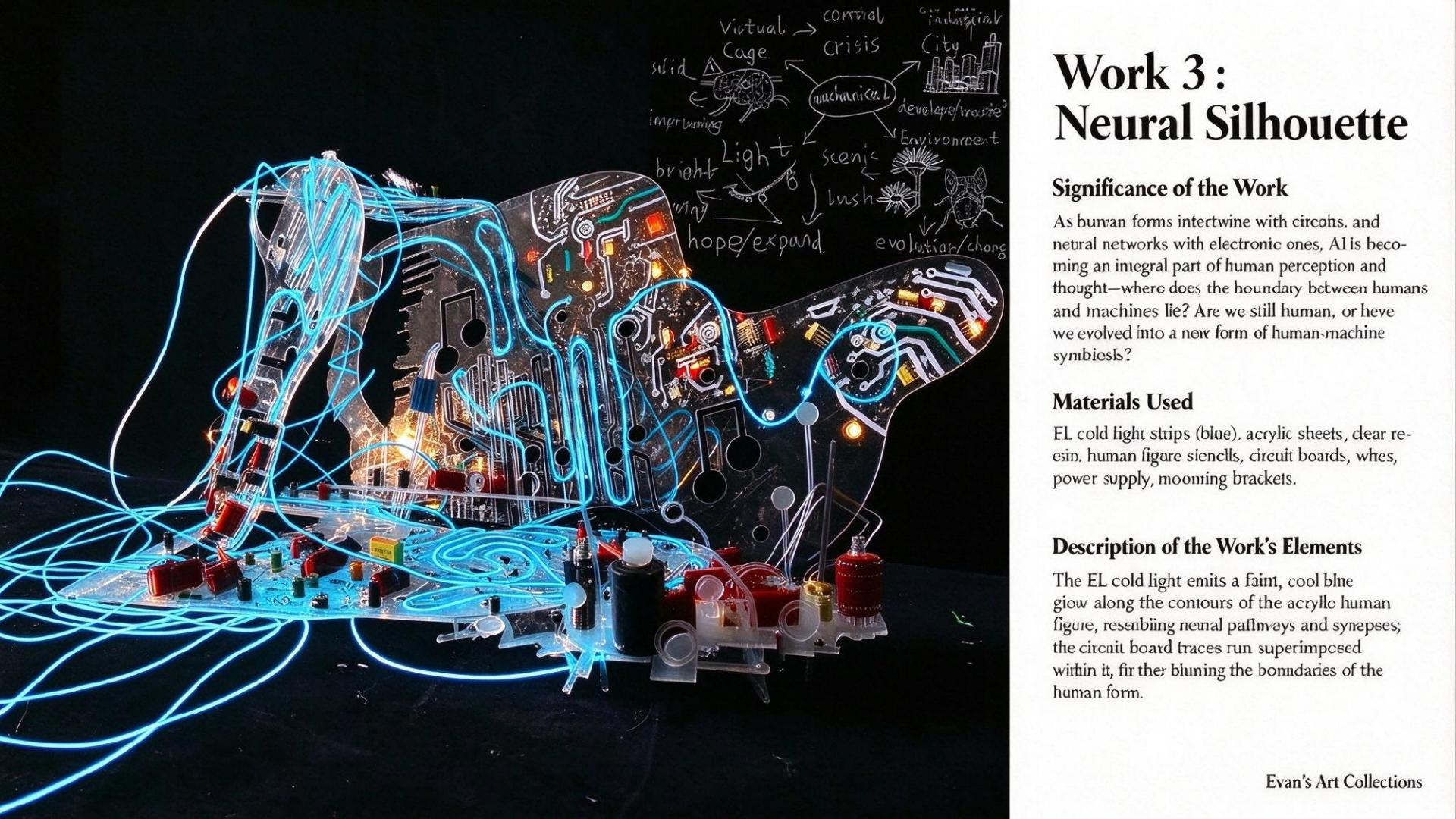
Work 3 — Neural Silhouette

Neural Silhouette — AP 3D Installation

Significance: As human forms intertwine with circuits, and neural networks with electronic ones, AI is becoming an integral part of human perception and thought — where does the boundary between humans and machines lie? Are we still human, or have we evolved into a new form of human-machine symbiosis? The EL cold light emits a faint, cool blue glow along the contours of the acrylic human figure, resembling neural pathways and synapses; the circuit board traces run superimposed within it, further blurring the boundaries of the human form.

Materials: EL cold light strips (blue), acrylic sheets, clear resin, human figure stencils, circuit boards, wires, power supply, mounting brackets.

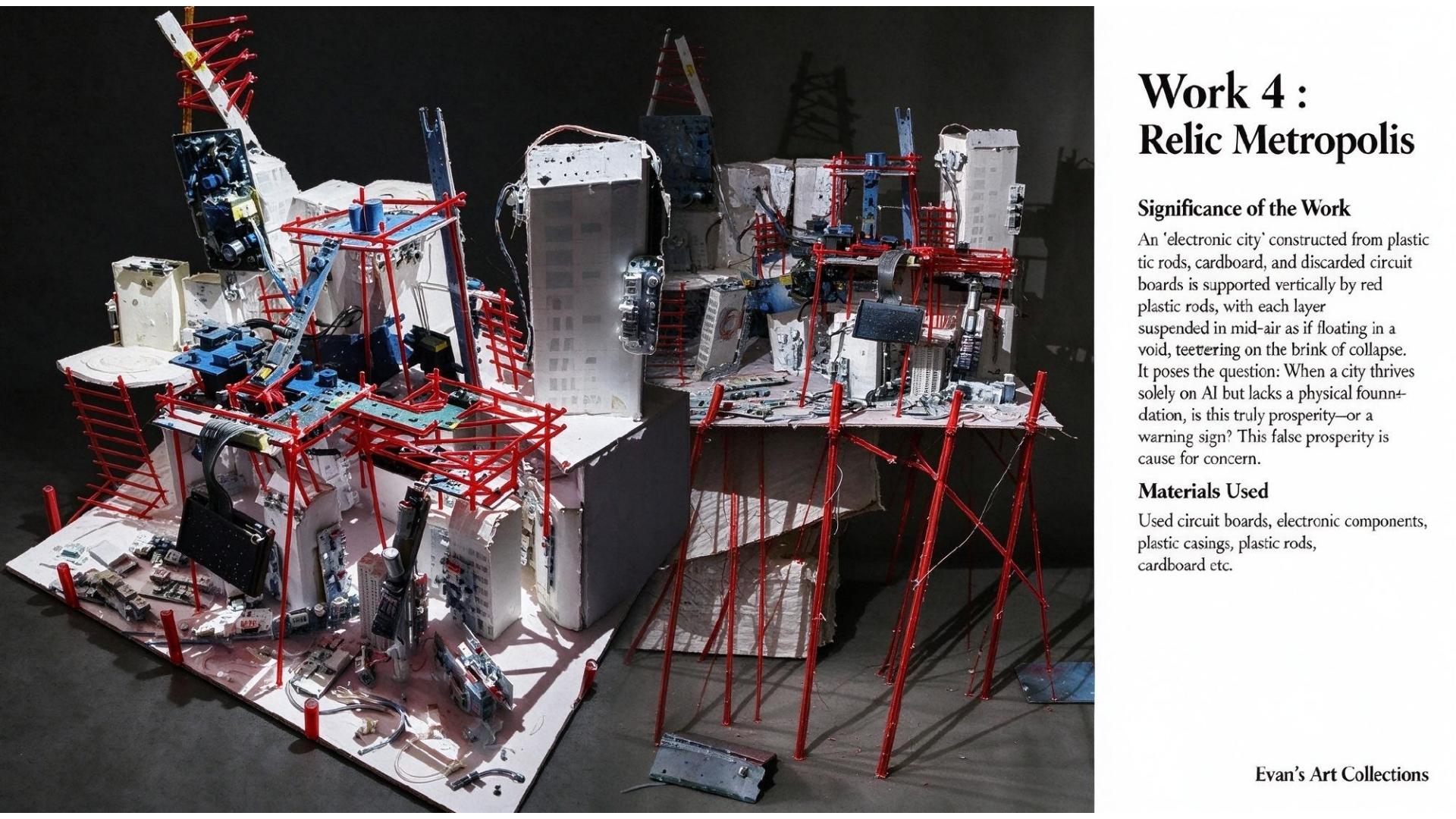
Work 4 — Relic Metropolis

Relic Metropolis — AP 3D Installation

Significance: An "electronic city" constructed from plastic rods, cardboard, and discarded circuit boards is supported vertically by red plastic rods, with each layer suspended in mid-air as if floating in a void, teetering on the brink of collapse. It poses the question: When a city thrives solely on AI but lacks a physical foundation, is this truly prosperity — or a warning sign? This false prosperity is cause for concern. The precarious structure mirrors my fear that a civilization built entirely on digital infrastructure may have no solid ground beneath it.

Materials: Used circuit boards, electronic components, plastic casings, plastic rods, cardboard, and glue.

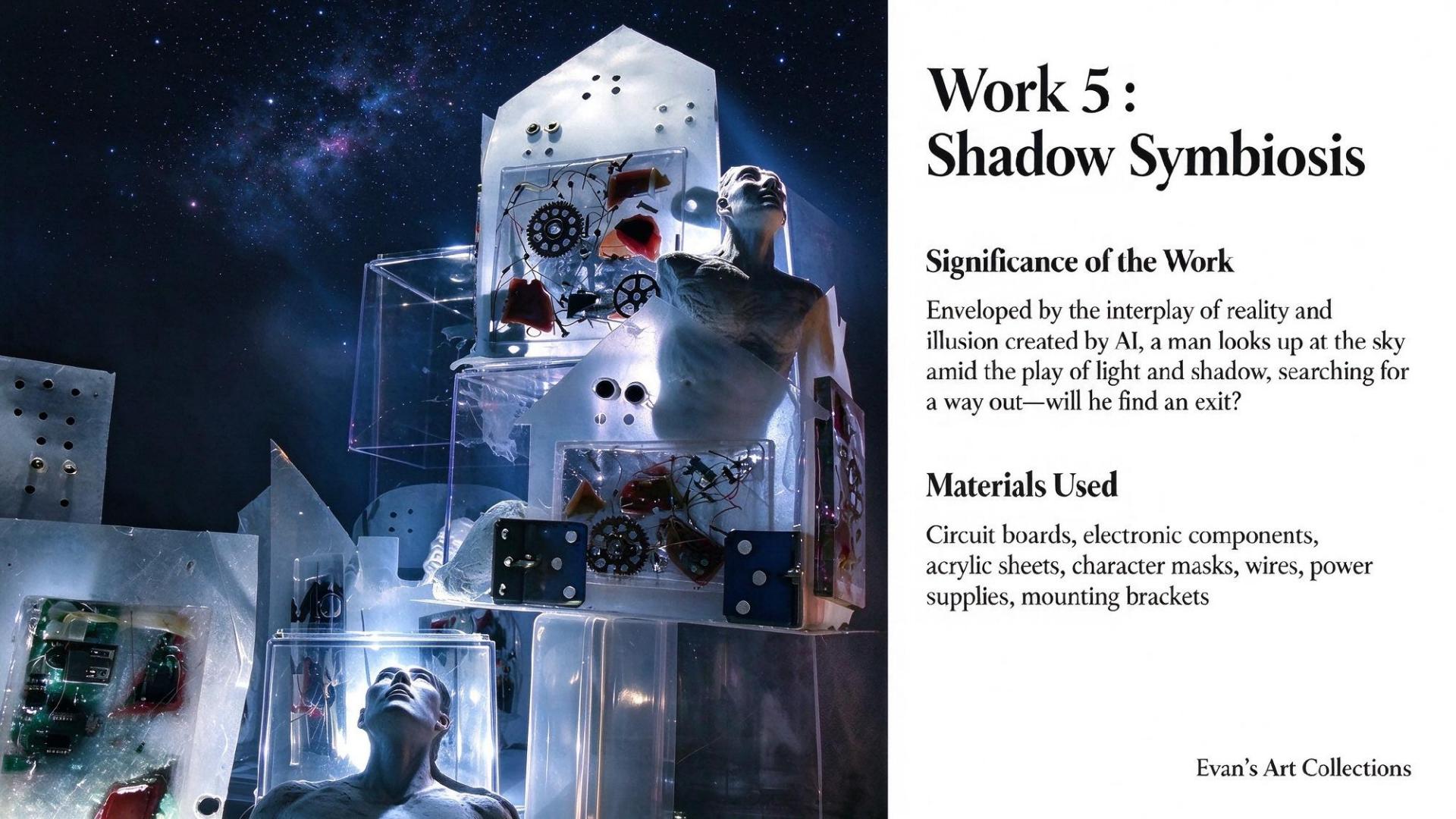
Work 5 — Shadow Symbiosis

Shadow Symbiosis — AP 3D Installation

Significance: Enveloped by the interplay of reality and illusion created by AI, a man looks up at the sky amid the play of light and shadow, searching for a way out — will he find an exit? This piece combines circuit boards, gears, acrylic sheets, and character masks inside transparent boxes, creating a layered narrative about entrapment and escape. The human figure reaching upward suggests both surrender and resistance — a moment frozen between becoming one with the machine and trying to break free.

Materials: Circuit boards, electronic components, acrylic sheets, character masks, wires, power supplies, mounting brackets.

Reflection

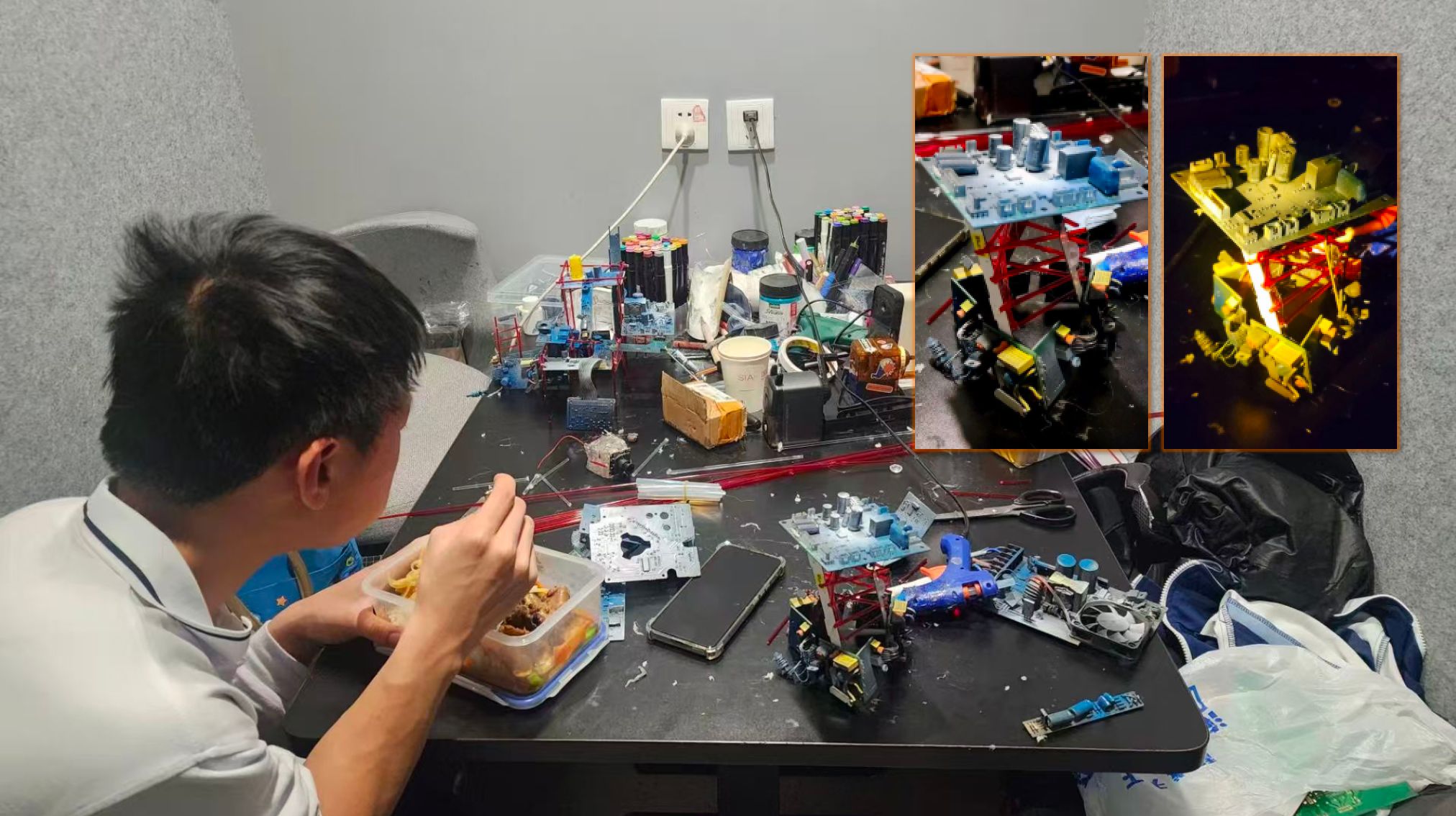
Relic Metropolis — AP 3D Installation

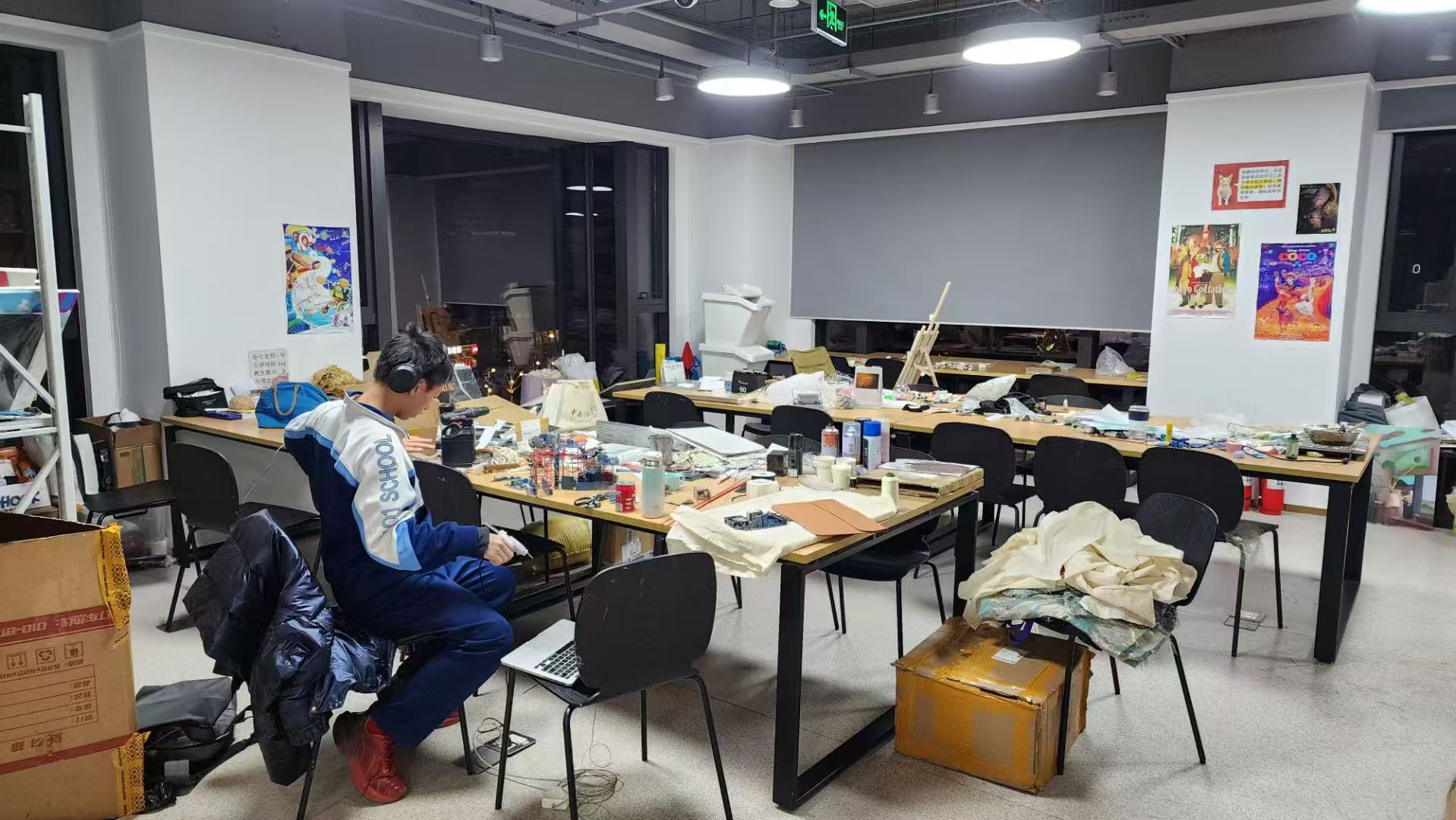
Before AP 3D Art, I thought 3D expression meant shaping a good-looking form and then attaching an idea to it. The concept lived on paper first; the material was decoration. This series forced me to reverse that order.

The discarded circuit boards, copper wire, and EL cold light were not props — they were already making an argument about the physical residue of our digital lives. I learned that material can carry the argument, not just carry the concept. Choosing a component is itself a sentence.

The second lesson was sequence. The five works are not five separate sculptures; they form a line that a viewer walks through — Origin, Infiltration, Integration, Collapse, Symbiosis or Escape. In 3D, space can narrate in time: the body moving past the work is part of how the work is read. The third lesson was light and craft. EL cold light turned static forms into something that breathes, and soldering, wiring, and acrylic forming taught me that precision itself is expressive — a rough joint and a clean joint say different things.

These lessons followed me into technical work. I now think of a good system the way I think of a good sculpture: it should carry both precision and meaning, and its structure should be readable by someone moving through it, not just by the person who built it.

FORM AND MEANING A new understanding of what a 3D work is really made of. Before, shape first, meaning after. Now, meaning first — and the form serves it. BEFORE · SHAPE FIRST “Does it look right?” Silhouette · lighting · finish Make the object, then attach an idea Meaning comes after The look is the destination Form leads, meaning follows SHIFT AFTER · MEANING FIRST “What needs to be said?” Question first, form earns its place The shape as an entry point The form serves it Meaning is the structure Craft in service of thought